How Long Does It Take to Learn Japanese? (And How AI Cuts That Time in June 2026)
When you search "how long does it take to learn Japanese," you want someone to give you the number without the runaround. The answer: the Foreign Service Institute benchmarks Japanese at 2,200 classroom hours for professional working proficiency. At five hours weekly, you're looking at nearly nine years. At fifteen hours, closer to three. The real question is not the total but whether those hours push you into actual conversation or keep you stuck in recognition mode. Most apps train you to read and listen, then leave you freezing when someone in Tokyo asks where you're from. Daily speaking practice with real-time feedback cuts that gap, and AI voice tutors let you bank those reps without paying $25 per session.
TLDR:
Japanese takes around 2,200 hours to reach professional fluency; at 15 hours per week, expect B1 in 12 months.
Three writing systems, SOV grammar, and keigo formality make Japanese Category V difficulty for English speakers.
Traditional methods stack hours into reading drills while starving you of speaking reps, the skill that matters most.
Real-time AI tutors give you unlimited speaking practice with particle correction and keigo switching across contexts.
ISSEN offers daily voice conversation practice with accent options and in-context flashcards from your actual speaking sessions.
Introduction
You typed "how long does it take to learn Japanese" into a search bar, and you want a number. Hours, months, years. Something you can plan against.
The honest answer: it depends on how hard you study and what method you use. The Foreign Service Institute classifies Japanese as a Category V super-hard language, requiring around 2,200 classroom hours to reach professional working proficiency. That's the benchmark diplomats train against, with full-time instruction and daily speaking practice.
Most self-learners hit nowhere near that pace. Below, we break down realistic timelines at different intensities, what each fluency milestone feels like, and how daily real-time AI conversation can cut months off the traditional path.
The Honest Answer: How Long Japanese Really Takes
Take the 2,200-hour benchmark and divide it by how many hours you can realistically put in each week, and that arithmetic tells you more about your timeline than any course brochure will. At five hours weekly, you're looking at roughly 8.5 years to professional proficiency. At fifteen hours, closer to 2.8 years. At thirty hours of full-time immersion, around 1.4 years. If you have a job, kids, and a commute, you fall into the casual or committed band, while the intensive band is mostly diplomats and full-time students.
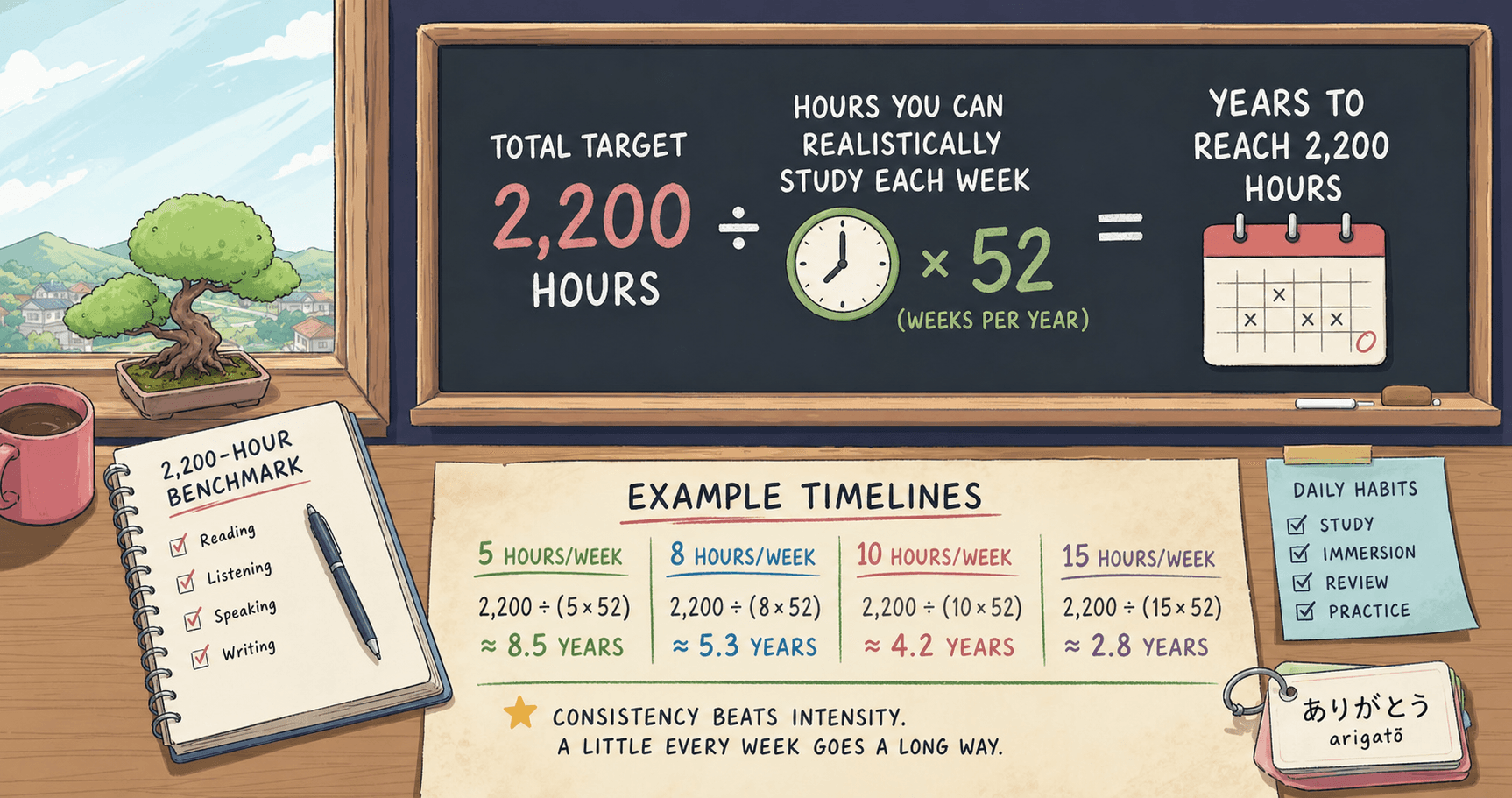
These numbers also assume your hours are well spent. Two hours of passive listening while folding laundry does not equal two hours of active conversation with feedback.
What Makes Japanese Easy or Hard for English Speakers
Five factors drive the Japanese learning curve for English speakers. Four work against you. One works in your favor.
Three writing systems. Hiragana and katakana are 46-character syllabaries you can memorize in weeks. Kanji is the wall: the jōyō list used in newspapers contains 2,136 characters, each with multiple readings depending on context.
Subject-object-verb grammar. "I eat sushi" becomes "I sushi eat." Particles like wa, ga, and wo mark grammatical roles, and getting them wrong changes your meaning.
Keigo and register. Honorific, humble, and polite forms shift by audience. A casual phrase to a coworker sounds rude to a client.
Forgiving pronunciation. Five vowels, a small consonant inventory, regular mora-timed rhythm. Speaking cleanly is easier than reading.
Near-zero vocabulary overlap. Outside loanwords like "konpyūtā," you cannot guess meaning from English roots.
Fluency Milestones: What Each Stage Actually Looks Like
CEFR levels map onto Japanese ability in concrete ways. Starting December 2025, JLPT score reports include a CEFR reference level, linking N5 through N1 to A1 through C1 on the internationally recognized CEFR scale.
CEFR | Approx hours | What you can actually do | JLPT |
|---|---|---|---|
A1 | ~150 | Order food, introduce yourself, ask for directions | N5 |
A2 | ~350 | Hold a 10-minute chat about hobbies and routines | N4 |
B1 | ~700 | Give opinions, handle daily errands | N3 |
B2 | ~1,300 | Join business meetings, follow TV news | N2 |
C1 | ~2,200 | Handle complex professional discussion | N1 |
Learners aiming for "I can live and work in Japan" want B2. Learners aiming for "I can travel and make friends" want a solid B1. Knowing which milestone you need saves you from training for a marathon when you signed up for a 10K.
Why Traditional Methods Take So Long
Textbooks and gamified apps stack hours into vocabulary lists, grammar drills, and reading comprehension, leaving speaking with the least time. You finish a Genki chapter feeling competent, then freeze when a barista in Osaka asks a real question.
The bottleneck is retrieval under pressure. Recognizing a kanji on a flashcard and producing the right particle mid-sentence are different cognitive tasks.
Japanese punishes this gap harder than most languages:
Natural-speed listening. Native speakers drop particles, contract verbs, and run mora together. Textbook audio is slowed for clarity, so your ear never trains on the real thing.
Picking the right keigo register. Choosing between irassharu, kuru, and mairu depends on who you are talking to and about whom.
Particle production on the fly. Picking the correct wo, ni, de, or e in 200 milliseconds while planning the rest of your sentence is a separate skill from reading them.
Gamified apps optimize for 5 to 10 minutes of daily streak maintenance. That cadence builds a vocabulary base, not a speaker.
How AI Tutoring Compresses the Timeline
Three mechanisms drive the speedup. First, output volume: a real-time voice tutor gives you unlimited speaking reps, the variable most learners starve. Swain's Output Hypothesis (1985) points to this exact gap, where forced production surfaces errors input alone never reveals.
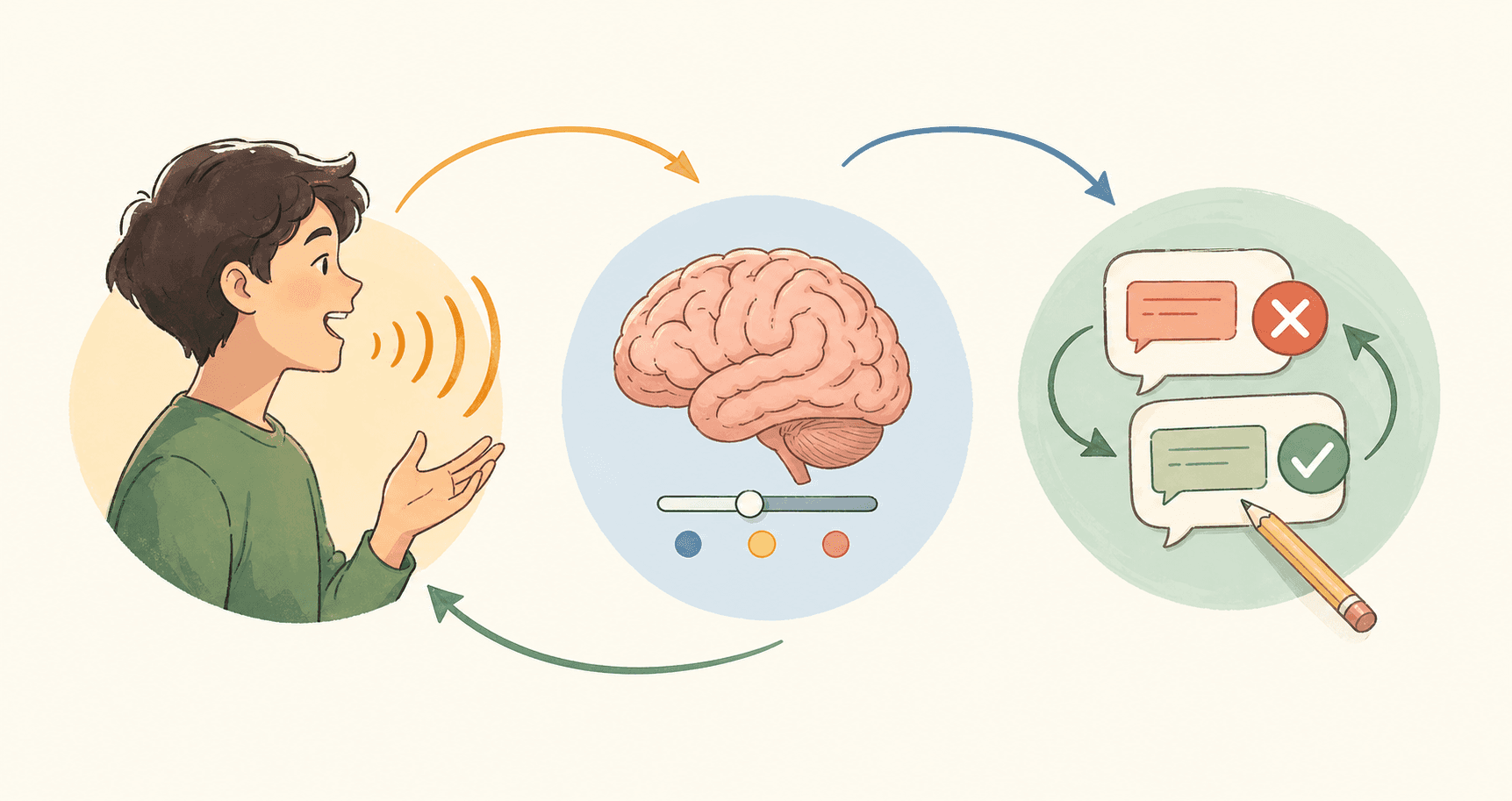
Second, comprehensible input tuned to your level. The tutor adjusts sentence complexity and kanji exposure so you understand most of what you hear, with one new piece per turn.
Third, in-the-moment correction on particles, verb endings, and keigo register while your sentence is still in working memory.
ISSEN tutors catch wa/ga slips, switch between Tokyo and Kansai accents, and run roleplay across business keigo, izakaya casual, and shopkeeper polite speech.
A Realistic Schedule to Reach Conversational Japanese Faster
Aim for 70 to 90 minutes a day, weighted toward speaking. Spend 30 minutes on live AI tutor sessions with full output on one topic, 20 minutes reviewing kanji flashcards tied to sentences you said, and 20 to 30 minutes listening to a podcast or drama during your commute. Background mode lets the speaking block happen on foot or hands-free. The SRS pulls from your conversation history, so each card carries the sentence you used it in.
Common Mistakes That Slow Learners Down
Seven traps cost Japanese learners the most time:
Avoiding speaking until kanji "clicks." Reading and speaking are different skills. Start speaking in week one, even with 50 words.
Leaning on romaji past day three. It trains the wrong sound shapes. Lock in hiragana and katakana in the first two weeks.
Ignoring pitch accent. Hashi means bridge or chopsticks depending on pitch. Shadow native clips daily and copy the melody.
Slowed textbook audio only. Add one podcast or drama at full speed every day, even if you catch 30 percent.
Drilling kanji on naked flashcards. Mine them from sentences you actually said or read.
Putting off keigo until N2. Mix desu/masu and humble verbs from B1.
FAQ
Can I become fluent in Japanese in 3, 6, or 12 months?
No, not to B2 or C1. At 15 hours a week, expect a solid A2 by month 6 and B1 around month 12. Three months of intensive study gets you functional A1.
Is Japanese harder than Mandarin or Korean?
FSI groups all three as Category V. Japanese has more grammar complexity than Mandarin (keigo, particles) but no tones. Korean shares the grammar structure but uses one alphabet, making literacy faster.
Do I need to live in Japan to become fluent?
No. Living there helps with listening volume and forced output, but plenty of B2 speakers have never lived in Japan. Daily AI conversation plus native media covers most of the input side.
How much does it cost to reach fluency in Japanese?
A weekly italki tutor at $25 per hour for two years runs around $2,600. Textbooks add $200. ISSEN is $20 to $29 per month with unlimited daily practice and a 10-minute free trial.
Can AI replace a human tutor for Japanese?
No. AI handles the daily speaking reps, particle correction, and keigo drilling that human tutors charge by the hour for. Human tutors stay valuable for cultural nuance, exam coaching, and scheduled accountability.
Conclusion
The 2,200-hour baseline does not bend, but how you spend those hours does. Casual learners stretch them across a decade. Committed ones compress them into under three years. The biggest lever is the ratio of speaking time to passive study, because retrieval under pressure is what turns a kanji you recognize into a sentence you can produce.
Start banking speaking hours today. A 10-minute trial conversation with an ISSEN Japanese tutor gets you into output mode immediately, with particle correction and keigo switching from the first turn. The clock starts the moment you open your mouth.
Final Thoughts on Timing Your Japanese Fluency Path
You already know the math gives you a range between casual and intensive. The variable that compresses or stretches that range is how early you start speaking and how many reps you log each week. Most learners wait until their grammar feels solid, then find out speaking is a different skill entirely. Try a 10-minute ISSEN session and start logging output hours while your study plan is still fresh.