
Start Speaking Beginner Korean: Nov 2026 Roadmap
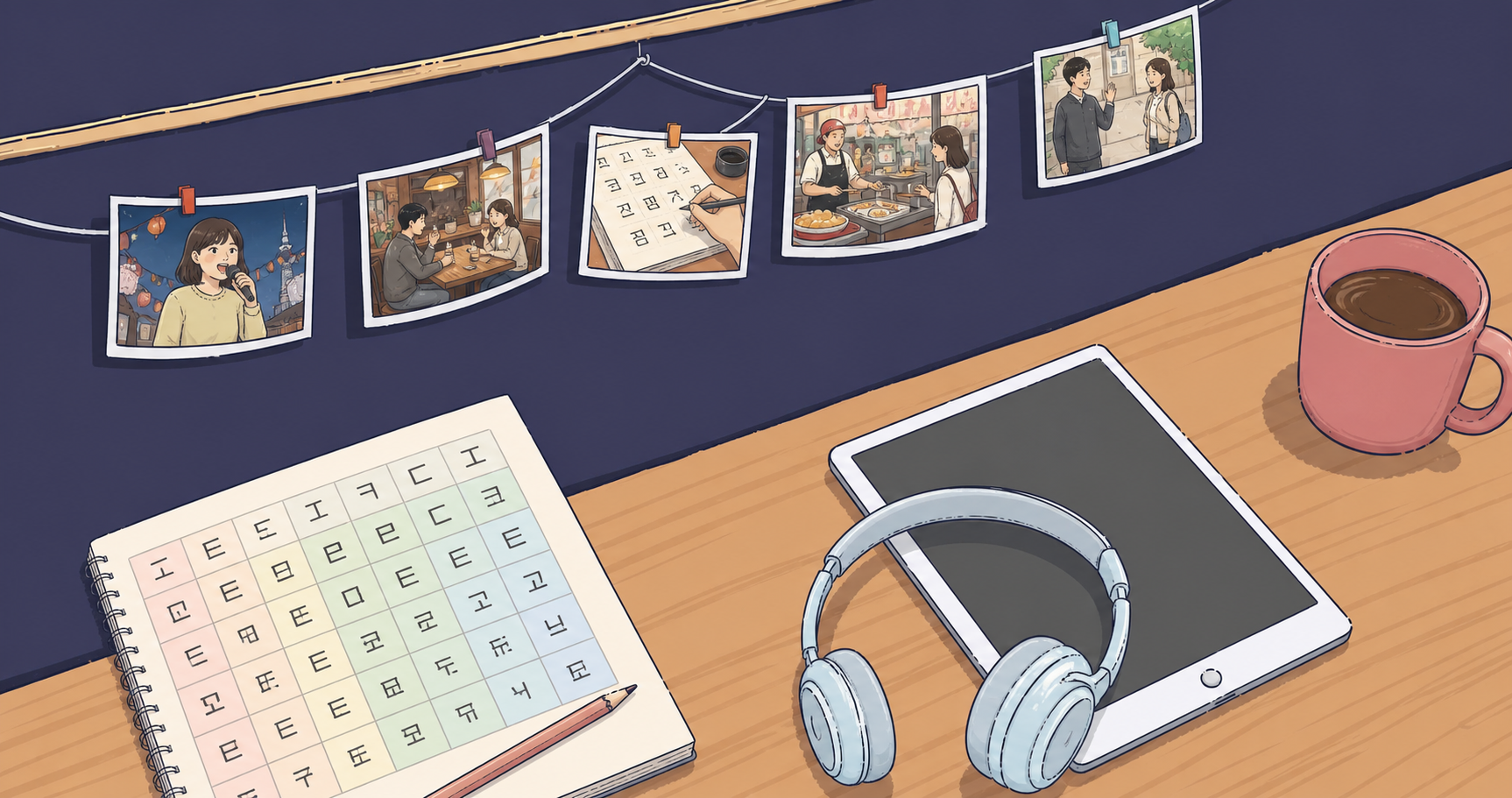
The jump from recognizing Hangul to actually speaking Korean is where most beginners quietly give up. You know the polite endings, you've drilled the numbers, and then someone asks a question and your mouth does nothing. We'll walk through what A1 Korean really covers, the five spots where learners get stuck, and a weekly routine that turns passive knowledge into speech you can use.
TLDR:
- A1 Korean covers Hangul, polite -요/-습니다 endings, and roughly 800 to 1,500 active words anchored to greetings, food, time, and directions.
- Five plateaus trap beginners: particle confusion (은/는 vs 이/가), two number systems, native-speed listening, honorific anxiety, and output freeze under pressure.
- Moving from A1 to A2 takes 150 to 250 hours of focused study; Korean is FSI Category IV at 2,200 hours to professional proficiency.
- Breakthrough cadence: 3 to 4 short voice sessions weekly drilling past -았어요/-었어요 and connectives -고/-서, since automaticity comes from output reps under pressure rather than more grammar charts.
- ISSEN separates Shadowing (pronunciation drills) from voice conversations (open-ended output), letting beginners run A1 scenarios like café orders without the social cost of mistakes.
Introduction
The Foreign Service Institute categorizes Korean as one of the hardest languages for English speakers. Starting out, it helps to know what "beginner" actually buys you. Maybe you got here through a K-drama binge, a BTS lyric stuck in your head, or a partner's family group chat.
A1 Korean, roughly the TOPIK I beginner band, is where Hangul stops looking like shapes and reads like letters, where introducing yourself clicks, and where polite endings like -이에요 and -습니다 start to feel less like puzzles. This piece walks through what you can say at A1, where most learners hit a wall, and how to push into A2. For a broader look at how long Korean fluency takes, see our detailed breakdown.
What beginner Korean actually means
Beginner Korean means handling short, predictable exchanges: reading Hangul syllable by syllable, introducing yourself, ordering food, and asking prices using polite -요 endings. The FSI puts Korean in Category IV, alongside Arabic, Chinese, and Japanese, so a slow start is the baseline. Stick to -요 and -습니다 forms and you will be read as polite in most situations.
Sample A1 exchange
Ordering coffee at a café:
- Customer: 아메리카노 하나 주세요. (Amerikano hana juseyo.) One Americano, please.
- Barista: 네, 사천 원이에요. (Ne, sacheon won-ieyo.) Sure. That'll be 4,000 won.
- Customer: 여기 있어요. 감사합니다. (Yeogi isseoyo. Gamsahamnida.) Here you go. Thank you.
- Barista: 좋은 하루 되세요. (Joeun haru doeseyo.) Have a good day.
Fixed phrases, high-frequency vocabulary, polite endings, no complex clauses.
The beginner Korean skill checklist
Run through the list below with a clear eye, much as you would a German A1 checklist before moving on. If you can tick most of these, you are solidly in beginner territory and ready to push toward A2.
- Read all Hangul letters (자음 and 모음) without romanization
- Introduce yourself using 저는 ~ 이에요/예요
- Count with both Sino-Korean (일, 이, 삼) and Native Korean (하나, 둘, 셋) numbers in the right contexts
- Use the particles 은/는 and 이/가 in simple sentences without second-guessing
- Conjugate present-tense verbs with the polite -아요/-어요 ending
- Order food and ask prices (주세요, 얼마예요, 감사합니다)
- Follow slow speech on familiar topics like family or food
- Write short Hangul messages for texts or notes
- Recognize around 800 to 1,500 high-frequency words
- Ask basic questions with 뭐예요?, 어디예요?, 언제예요?
Typical vocabulary range at beginner
At A1, you are working with roughly 800 to 1,500 active words, a fraction of what someone aiming for Spanish B2 eventually needs, which maps closely to the TOPIK I beginner vocabulary band. The categories are narrow: greetings, family, food, basic verbs, time, directions, and numbers carry most of your daily load.
Korean's two parallel number systems trip up most beginners. Native Korean numbers (하나, 둘, 셋) count people, hours, and age. Sino-Korean numbers (일, 이, 삼) handle money, minutes, dates, and phone numbers.
Category | Example Korean | English |
|---|---|---|
Greetings | 안녕하세요 | Hello (polite) |
Numbers (Native) | 하나, 둘, 셋 | one, two, three |
Numbers (Sino) | 일, 이, 삼 | 1, 2, 3 |
Food & dining | 주세요, 맛있어요 | please give me, this is delicious |
Directions | 어디예요? | Where is it? |
Time | 지금, 오늘, 내일 | now, today, tomorrow |
Grammar you should have locked in
At A1, grammar is mostly about particles and polite endings. Lock these six in and most beginner sentences will fall into place.
- Topic markers 은/는 introduce a topic or set contrast. 저는 학생이에요. (I am a student.)
- Subject markers 이/가 identify who or what is doing something. 고양이가 있어요. (There is a cat.)
- Object marker 을/를 marks the direct object. 책을 읽어요. (I read a book.)
- Polite present -아요/-어요 is everyday polite speech. 가요, 먹어요. (I go, I eat.)
- Copula 이에요/예요, the "to be" form for identity. 학생이에요. (I am a student.)
- Negation 안 and -지 않다 for basic negation. 안 가요. (I don't go.)
TOPIK I beginner grammar maps roughly to CEFR A1 and early A2. Particles carry meaning you cannot skip, so drill them inside full sentences, not isolated charts.
Where beginner learners get stuck
Five plateaus trap almost every beginner, not unlike the well-documented French A2 plateau. Naming the cause is the first step past it.

Particle paralysis
은/는 versus 이/가 feels arbitrary because English has no equivalent. Particles encode information structure that English speakers normally handle through word order and stress, which is why memorizing a chart does not make them stick. Learners freeze or drop them, which natives notice immediately.
Two number systems under pressure
Reading 삼천 원 is fine. Hearing a cashier say it while you count change and hold a tray is where the system collapses. Sino-Korean for money and minutes, Native Korean for ages and hours, both in one transaction.
Listening collapse at native speed
Textbook audio is slower than real Korean. 뭐 해요? compresses into 뭐해 and the beginner who parsed it on paper hears a blur.
Honorific anxiety
The gap between -요 and -습니다 is small on the page and enormous in the head. Fear of offending blocks the reps that would resolve it.
Output freeze
You follow the podcast, then someone asks 어디에서 왔어요? and nothing comes out. Swain's Output Hypothesis (1985) explains why: producing language under pressure forces you to notice gaps that reading glides over, converting passive knowledge into active speech.
How to break through to A2 Korean
A2 is where sentences stretch past the present tense and connect into real thought. Getting there means volume on four fronts, tied to the grammar that unlocks the band.
A weekly cadence that works
- Speaking reps: 3 to 4 AI voice tutor sessions per week, 15 minutes each, drilling past-tense -았어요/-었어요 and future -ㄹ 거예요 under conversational pressure.
- Listening: 20 to 30 minutes daily of slow Korean podcasts or drama clips with subtitles.
- Vocabulary: 10 to 15 conversation-anchored words per day through SRS, pulled from sentences you actually used.
- Writing: 2 short exercises per week, chaining clauses with -고 and -서.
You can memorize the past, future, and connective charts in an afternoon, the same kind of grammar leap learners face reaching German B2 from B1. Making them automatic takes weeks of output, where 어제 뭐 했어요? forces your mouth to find the ending.
A 2024 review of AI speaking chatbots reports gains in anxiety reduction and speaking outcomes for L2 learners across text and voice formats. Our own framing: a voice-first AI tutor is the format best suited to filling the daily volume gap at A1, while a human tutor once a week catches fossilizing errors.
Using an AI tutor at beginner Korean
At A1, knowledge is rarely the barrier. You know 안녕하세요. You froze when someone said it back. An AI voice tutor removes the social cost of the first fifty reps: mispronounce it ten times and the tutor keeps responding, adjusting speed and vocabulary to stay in your A1 band turn by turn.
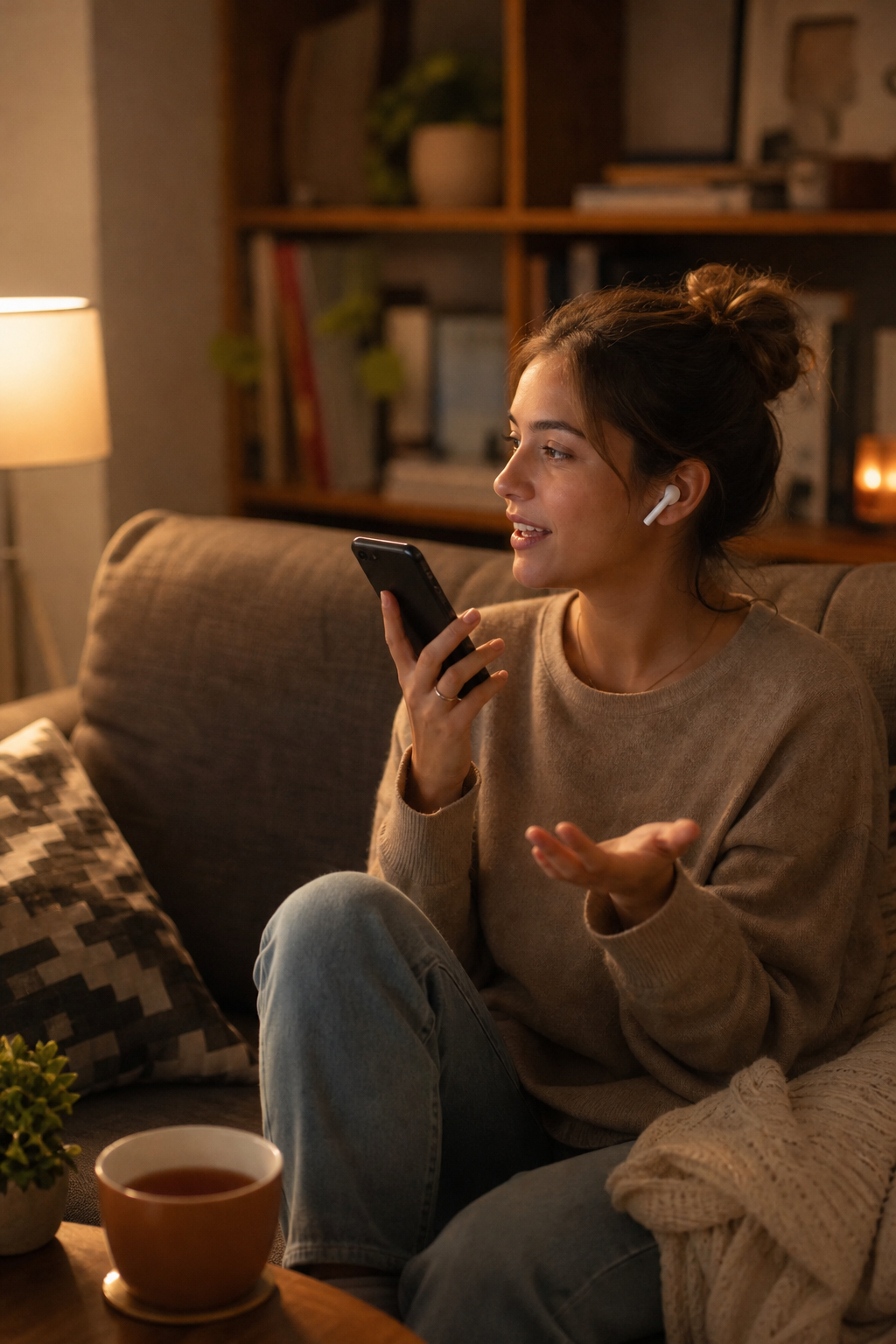
Pronunciation drills and open conversation live in separate modes inside ISSEN, a structure that also applies to learners working through the French A1 level. Shadowing, where you repeat native audio to train rhythm, is a dedicated Shadowing mode. Open-ended output happens in voice conversation. Keep them distinct.
Four prompts worth running this week:
- "Order coffee and a pastry at a café in Seoul."
- "Introduce yourself using name, country, job, and hobby in polite -요 form."
- "Ask directions to the subway and parse the reply."
- "Describe your family using 저희 가족은..."
An AI tutor handles the daily volume beginners need. Pair it with a weekly human tutor to catch the fossilizing habits an AI will not flag.
Sample conversation at beginner Korean
Here is a short dialogue at a café, the kind of exchange you should be able to handle at A1.
Target language:
- 손님: 안녕하세요. 아메리카노 한 잔 주세요.¹ ² ³ (Sonnim: Annyeonghaseyo. Amerikano han jan juseyo.)
- 직원: 네, 뜨거운 거요? (Jigwon: Ne, tteugeoun geoyo?)
- 손님: 아니요, 아이스로 주세요. (Sonnim: Aniyo, aiseuro juseyo.)
- 직원: 사이즈는 어떻게 하세요? (Jigwon: Saijeuneun eotteoke haseyo?)
- 손님: 작은 거로 할게요. (Sonnim: Jageun georo halgeyo.)
- 직원: 네, 사천 오백 원이에요. (Jigwon: Ne, sacheon obaek won-ieyo.)
- 손님: 카드로 할게요. (Sonnim: Kadeuro halgeyo.)
- 직원: 감사합니다. 좋은 하루 되세요. (Jigwon: Gamsahamnida. Joeun haru doeseyo.)
English translation:
- Customer: Hello. One Americano, please.
- Staff: Sure, hot?
- Customer: No, iced please.
- Staff: What size?
- Customer: I'll take a small.
- Staff: Okay, that's 4,500 won.
- Customer: I'll pay by card.
- Staff: Thank you. Have a good day.
Notes:
- 안녕하세요 uses the polite -요 form, the default register for strangers and service staff at A1.
- 주세요 attaches to nouns for high-frequency A1 requests: 물 주세요, 메뉴 주세요, 영수증 주세요.
- 잔 is a counter for cups. Korean pairs numbers with counters depending on what you are counting (잔 for cups, 개 for generic items, 명 for people), a feature English lacks.
How long to reach A2 Korean
Korean sits in the FSI's hardest tier, with roughly 2,200 classroom hours estimated to reach professional working proficiency (ILR 3, roughly CEFR C1). Scaling down, moving from A1 to A2 typically takes 150 to 250 hours of focused study for self-directed adults. Treat these as institutional estimates, not promises.
Commitment | Weekly hours | Time to A2 |
|---|---|---|
Casual | 3 hours/week | 12 to 18 months |
Steady | 5 to 7 hours/week | 6 to 10 months |
Intensive | 10+ hours/week | 3 to 5 months |
Immersion | 20+ hours/week | 6 to 10 weeks |
Two weeks of daily voice practice will make the next café exchange feel less terrifying. Genuine A2 takes months.
FAQ
Am I really a beginner, or already A2?
Can you form past tense with -았어요/-었어요 and connect clauses with -고 or -서 without stopping to think? If you hesitate on either, you are still A1.
How do I test my Korean level?
TOPIK I is the government-administered beginner test covering levels 1 and 2, roughly comparable in scope to what JLPT N4 measures for Japanese learners. Free CEFR self-assessments give a rough placement in minutes. Inside ISSEN, the tutor calibrates to your output turn by turn.
Can I skip Hangul and use Romanization?
No. Romanization fossilizes bad pronunciation and blocks reading, since menus, signs, and texts in Korea use Hangul. The alphabet takes a weekend.
Is beginner Korean enough for a trip to Seoul?
Yes for cafés, taxis, and shopping. No for hospital visits or bureaucracy, where you need a translator.
Where this goes next
Minjun is a software engineer in Berlin learning Korean to speak with his partner's family in Busan. He stumbles on 이/가 versus 은/는 and has three months before the next family dinner. Over the next two to three years, AI voice tutors will carry a persistent model of those stumbles, pre-load family-dinner role-plays the week before his flight, and shift between Seoul and Busan accents depending on who he is talking to.
Start a 10-minute conversation with ISSEN.
Final thoughts on learning Korean as a beginner
Your A1 toolkit is narrow but real: Hangul, polite -요 forms, a thousand high-frequency words, and the confidence to order a coffee. Closing the gap to A2 is less about new material and more about the reps that turn 어제 뭐 했어요? into an answer instead of a stare. Grab one prompt from this piece and run it this week. Start a 10-minute conversation with ISSEN when you are ready to hear your own voice do the work.