
Mandarin Speaking Fluency Through AI Conversation (Nov 2026)
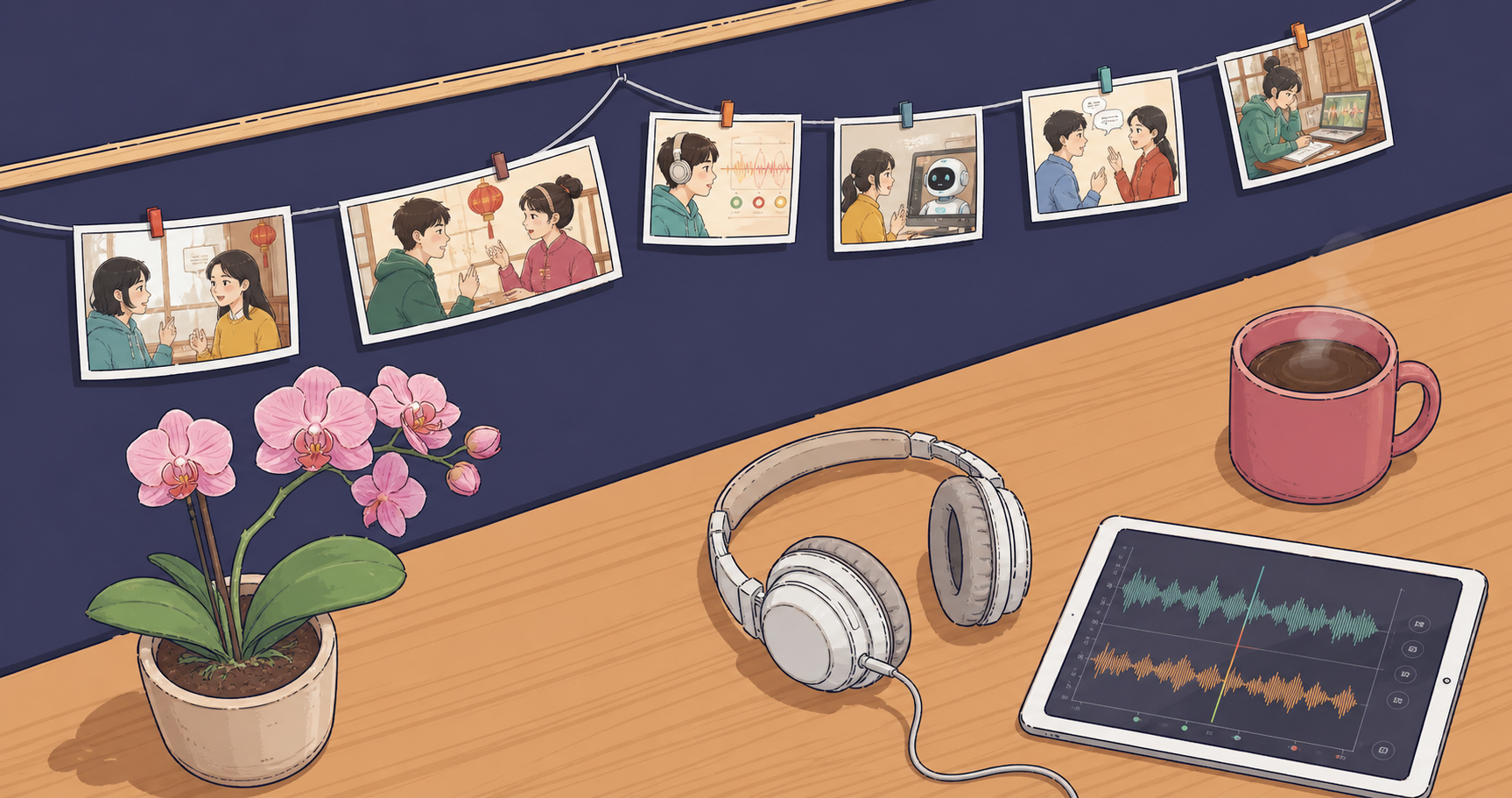
Learning how to learn Chinese is one thing; building the kind of speaking fluency where you can actually hold a conversation is another problem entirely. Most learners spend their hours on characters and flashcards and arrive at their first real Mandarin conversation totally unprepared for the speed, the tones in context, and the pressure of responding in real time. What actually moves the needle is daily spoken output, and this guide walks through how to build that into your routine from the start.
TLDR:
- Mandarin sits in FSI's Category IV at 2,200 class hours to professional proficiency, but a conversational level around HSK 3 to 4 is reachable in 500 to 700 hours if you put speaking output first.
- Tones and Pinyin require active production from day one. Patricia Kuhl's research shows live interactive exposure builds phonetic learning that passive audio alone cannot replicate.
- Swain's Output Hypothesis explains why reading Mandarin and speaking it are separate cognitive skills: producing language under time pressure forces you to notice gaps that input-only study never surfaces.
- A 44-study systematic review found shadowing improves comprehensibility, fluency, and prosody, making 5 to 10 minute focused sessions a more effective tone-building method than passive replay.
- ISSEN is a real-time AI voice tutor that runs Mandarin conversations with a separate dedicated Shadowing mode, conversation-anchored SRS flashcards, and a background mode for hands-free practice during commutes.
How Hard Is Chinese, and How Long Does It Take?
Mandarin sits in FSI's Category IV, the hardest tier for English speakers, with professional working proficiency estimated at around 2,200 class hours. That's nearly three times what French or Spanish require.
The counterintuitive part is where those hours go. Chinese grammar is genuinely simple by world language standards: no verb conjugations, no gendered nouns, no case endings. Almost all of that time goes toward tones and characters, not syntax. A conversational level around HSK 3 to 4 is reachable in 500 to 700 hours, which is a more manageable target when you understand how long it takes to learn Mandarin overall.
Knowing this upfront matters because speaking practice is where most learners fall furthest behind, and choosing the right methods early compounds across hundreds of hours.
Proficiency Level | Approximate Hours | What You Can Do |
|---|---|---|
Basic survival (HSK 1 to 2) | 150 to 200 hours | Greet people, order food, handle simple transactions |
Conversational (HSK 3 to 4) | 500 to 700 hours | Hold everyday conversations, discuss familiar topics |
Professional working proficiency | 2,200 hours (FSI estimate) | Work in Mandarin, read news, handle complex topics |
Start with Tones Before Anything Else
Mandarin has four tones plus a neutral: flat (first), rising (second), dip-then-rise (third), and falling (fourth). The same syllable "ma" means mother, hemp, horse, or scold depending on which tone you use.
Most beginners treat tones as something to clean up later. That instinct backfires. Every mispronounced word you repeat without correcting is a habit your mouth is memorizing, and rewiring those habits costs far more time than building them correctly from the start.
Learn every new word with its tone from day one. Tone pairs, practicing two-syllable combinations like first-fourth or third-second, are especially useful because tones interact differently in sequence than in isolation. Passive exposure alone won't cut it here. As Patricia Kuhl's infant Mandarin studies showed, live interactive exposure produces phonetic learning that passive audio does not. You need to produce tones out loud, get feedback, and repeat under real communicative pressure.
Learn Pinyin as Your Pronunciation Bridge
Pinyin is the romanization system that maps Mandarin sounds to Latin letters. Learning it early means you can start building a sound library before you've memorized a single character, and a solid foundation lets you look up words, type in Chinese, and study pronunciation independently of the writing system.
Where learners consistently stumble is assuming the letters sound like English. The "x" in "xie" sounds nothing like the English "x." The "q" in "qing" has no English equivalent. "Zh," "ch," and "sh" are retroflex sounds made with the tongue curled back. Reading Pinyin as if it were English is one of the fastest ways to fossilize bad pronunciation early.
Spend a focused week on Pinyin before adding vocabulary, running through each initial, final, and tone combination with audio until the correct sound comes automatically.
Simplified vs. Traditional Characters: Which Should You Learn
The answer here is mostly about geography and goals, not difficulty.
Simplified characters are standard in Mainland China and used in most language courses, textbooks, and apps worldwide. Traditional characters dominate in Taiwan and Hong Kong. If your goal is to work in Shanghai, study at a Chinese university, or communicate with the majority of Mandarin speakers globally, Simplified is the practical choice.
For most adult learners, recognition matters far more than handwriting. You need to read menus, signs, WeChat messages, and subtitles. Focusing early hours on recognizing characters in context will take you further than drilling stroke order by hand.
If you later want to read Traditional characters, the transition from Simplified is manageable. The two systems share enough structure that intermediate learners can bridge between them without starting over.
Build Vocabulary Through Patterns, Not Grammar Rules
Chinese grammar has a reputation borrowed from the wrong parts of the language. The tones and characters are genuinely hard. The grammar itself ranks among the simplest of any major language.
Sentences follow subject-verb-object order that mirrors English. Verbs don't conjugate, there are no gendered articles, and "I eat rice," "I ate rice," and "I will eat rice" differ only by a time word or particle.
The trap is subtle. Learners drill grammar rules consciously, one at a time, and speaking stays slow because fluency requires patterns to be automatic, not analyzed. Acquiring vocabulary through whole sentences in context works better. When you encounter "我很高兴认识你" in a real conversation and understand it from surrounding context, your brain encodes the phrase as a chunk, storing vocabulary, tone, and structure together. Paul Nation's vocabulary research found that word cards work best alongside meaning-focused input and output, not as a standalone method.
Spaced repetition strengthens what input introduces. When a flashcard surfaces the actual sentence you heard instead of a stripped word, retention at delayed review improves meaningfully. Timing matters too: reviewing a word within 24 hours of first encountering it in context captures the memory trace before it fades, which is why conversation-anchored review outperforms end-of-week vocabulary sessions. The sentence is the unit, not the word.
How to Practice Chinese Speaking When You Have No One to Talk To
Reading and understanding Mandarin in written form and producing it under conversational pressure are genuinely different cognitive processes. Most self-study methods build the first skill without touching the second, which is why so many learners can decode a sentence but freeze the moment someone asks them a question.
Merrill Swain's Output Hypothesis explains why: producing language under time pressure forces learners to notice gaps that input-only study never surfaces. Recognition and speaking do not automatically transfer to each other.
Some practical starting points when no conversation partner is available:
- Self-talk in Mandarin during routine tasks: narrate what you're doing, describe objects around you, think through decisions out loud in the language.
- Use the shadowing technique by repeating sentences immediately after hearing them, matching tone and rhythm as closely as possible.
- Record yourself speaking for 60 to 90 seconds on a simple topic, then replay it to catch tone errors and unfinished sentences.
Spoken output volume matters more than perfection. Every sentence you produce out loud, even imperfectly, builds the retrieval path that automatic speech runs on later.
Use Shadowing to Fix Tones and Rhythm
Shadowing means listening to a short passage of native speech, then repeating it immediately at native speed while matching tone, rhythm, and prosody as closely as possible. For Mandarin, the technique does something drills and flashcards cannot: it forces your mouth, ears, and breath to work together in real time, building muscle memory for tones in connected speech instead of in isolation.

A 44-study systematic review found shadowing improves comprehensibility, fluency, and prosody across learner levels. The prosody findings matter especially for Mandarin because tonal interaction changes at conversational speed in ways that isolated drills never expose you to.
Short, focused sessions of 5 to 10 minutes outperform long passive replays. Pick a clip where you understand at least 70 to 80 percent of the content, and isolate difficult tone sandhi patterns, where third tones shift in sequence, before moving forward. ISSEN's dedicated Shadowing mode handles this kind of structured drill work separately from open conversation sessions, with pause-and-repeat functionality across multiple regional accents.
Build a Daily Habit Around Listening and Speaking
Consistency compounds in a way that irregular marathon sessions simply cannot. Thirty minutes of Chinese conversation daily for two months builds more speaking automaticity than eight hours crammed into a weekend, because your brain consolidates what it practiced the day before during sleep, then returns to practice again before that consolidation fades.

The practical setup is simpler than most learners expect. Passive listening during commutes, chores, or walks handles your input volume without requiring extra time. Native podcasts, YouTube conversations, or short drama clips at your comprehension level keep your ear calibrated to real Mandarin rhythm. Then one dedicated speaking window, even 15 to 20 minutes, converts that input into output before the day ends.
That pairing within the same daily window matters. Listening primes vocabulary and tonal patterns; speaking the same day forces retrieval before the memory trace weakens. ISSEN's background mode makes the listening layer genuinely frictionless, running hands-free from a locked screen during a walk or commute so there's no barrier between an idle moment and an active session.
How AI Tutors Change Chinese Speaking Practice
Access to patient, level-appropriate Chinese conversation practice has always been the bottleneck for home learners, whether because of cost, scheduling, or the anxiety of speaking in front of someone who might judge every mispronounced tone, which is one reason so many learners compare language learning apps for speaking before committing.
AI voice tutors change that constraint. A 2024 systematic review of AI conversation tools for L2 speaking practice found consistent benefits for anxiety reduction, confidence, and speaking outcomes, particularly for learners who struggled to find low-stakes environments to produce output. When no human is judging each mistake, learners speak more, get more retrieval reps, and build the automaticity that fluency requires.
AI conversation fills a specific gap, though, not the whole stack, which is why comparing the best AI voice tutors for language learning matters before picking one. Listening to native media, studying characters, and reviewing vocabulary through spaced repetition still require deliberate effort outside of sessions. AI tutors work best as the daily output layer, converting passive knowledge into spoken language under real-time pressure.
When to Add Human Tutors to Your Stack
AI conversation practice builds volume. Human tutors build precision.
The two serve different functions. A human tutor catches fossilized errors that an AI tutor may absorb after enough repetition: consistently dropping the aspect particle "le" under pressure, or tones deteriorating as sentences get longer.
Cultural pragmatics is also harder to replicate. How a native speaker softens a refusal, the register gap between speaking to a colleague versus a stranger, the unwritten rules around silence and interruption in Mandarin conversation: a good human tutor transmits these through natural exchange in ways programmatic feedback cannot fully match.
The stage where a periodic human session pays off most is once you can already hold a basic conversation and recover from stumbles without abandoning sentences entirely. Before that point, a tutor spends most of the session managing anxiety and filling gaps that AI practice can handle at a fraction of the cost. After it, a weekly or biweekly session on Preply or italki becomes a precision layer: targeted correction of calcified errors, unscripted conversational pressure, and accountability for the areas your daily practice with one of the best personalized language learning apps quietly avoids.
Human tutors are a complement to speaking volume, not a substitute for it, a principle that holds just as true when comparing Spanish language learning apps for speaking practice as it does for Mandarin.
ISSEN: AI Voice Tutoring Built for Daily Chinese Speaking Reps
ISSEN is a real-time AI voice tutor built around the speaking bottleneck this article describes, and understanding how AI speaking practice works helps explain why it closes that gap. From your first session, it runs full Mandarin conversations, adjusting vocabulary, sentence length, and speaking pace within each turn to hold the i+1 band as a continuous condition instead of a one-time placement setting.
A few features matter most for Chinese learners, the kind worth weighing against other AI apps for practicing real conversations. Smart turn detection removes push-to-talk entirely, so conversation flows without button presses interrupting your output rhythm. Background mode lets you run sessions from a locked screen during a walk or commute, converting passive time into speaking reps without blocking your day. Conversation-anchored SRS flashcards surface vocabulary in the exact sentence context where you first encountered it, giving each word the situational memory hook that makes delayed retention meaningfully stronger than drilling isolated items.
ISSEN runs on iOS, Android, and web with instant sync across devices. At a flat monthly rate versus per-session human tutor pricing on Preply or italki, the cost per speaking rep is substantially lower for learners who need daily practice volume, which is worth weighing against other language learning resources. There's a 10-minute free trial to start your first conversation.
Try ISSEN free for 10 minutes at www.issen.com.
Final thoughts on Chinese speaking practice and AI tutors
Mandarin's difficulty is real, but most of that difficulty concentrates in two areas: tones and characters. The grammar gets out of your way quickly, which means your hours are better spent producing spoken sentences than memorizing rules. What holds most learners back past the early stages remains the absence of a low-stakes place to actually speak every day.
Consider Wei, a software engineer in Austin who moved from Chengdu five years ago and whose Mandarin has quietly rusted from disuse. He can still read WeChat messages from his parents without much trouble, but the last time he tried a phone call he found himself pausing mid-sentence to reconstruct tones he once said automatically. He has 20 minutes most mornings before his commute. What he needs is not a grammar workbook (his grammar was never the problem) but a place to produce real spoken Mandarin under time pressure, with something on the other end that responds and pushes back.
That is exactly the gap a real-time AI voice tutor fills: daily output reps available on demand, no scheduling required, no anxiety about wasting a human tutor's time on elementary stumbles. The tools that will matter most for learners like Wei over the next few years are the ones that make that daily spoken practice as frictionless as putting on headphones.
Try ISSEN free for 10 minutes, and make spoken output the daily habit your Mandarin practice has been missing.
FAQ
Can you learn Mandarin with AI conversation practice alone, or do you still need other study methods?
AI conversation practice handles the output layer that most self-study methods leave untrained, but it covers one piece of the stack. Characters, tone drills in isolation, and vocabulary review through spaced repetition still require deliberate work outside of sessions. An AI Chinese tutor like ISSEN works best when it sits alongside listening input, shadowing, and structured character study, converting what those methods build into spoken language under real-time pressure.
What's the best way to practice Chinese speaking when you have no conversation partner?
Start with self-talk during routine tasks and shadowing native audio to build output volume without a partner, then add an AI voice tutor for the part those methods cannot provide: real-time response and correction when you produce something wrong. Solo methods are genuinely useful for accumulating reps, but they have a structural ceiling: no unpredictable conversational pressure, no external correction. An AI tutor closes that gap without requiring you to schedule around another person's availability.
How long does it actually take to reach conversational Mandarin, and does learning Mandarin with AI speed that up?
FSI's Category IV estimate puts Mandarin at 2,200 class hours for professional working proficiency for English speakers, but a functional conversational level around HSK 3 to 4 is achievable in 500 to 700 hours with consistent effort. AI tutoring does not compress those total hours, but it removes the access bottleneck that slows most learners down: the scarcity of patient, level-appropriate speaking practice. When speaking reps are available on demand instead of rationed by tutor schedules, the productive hours inside that timeline compound faster.
Should I use a Preply or italki tutor for Mandarin, or is an AI Chinese tutor enough?
The two serve different functions and the stage you are at determines the split. Before you can hold a basic conversation and recover from stumbles mid-sentence, a human tutor spends most of the session managing anxiety instead of correcting targeted errors. After that threshold, a weekly or biweekly session on Preply or italki becomes genuinely useful for catching fossilized errors, cultural pragmatics, and register nuances that AI practice can underweight. The practical model for most learners is daily AI sessions for speaking volume, with periodic human sessions for precision work once there is enough fluency to make that precision actionable.
How do I use shadowing to fix Mandarin tones without reinforcing bad habits?
Pick audio where you understand at least 70 to 80 percent of the content, then repeat immediately at native speed while matching tone, rhythm, and prosody, beyond just the words. The critical constraint is isolating third-tone sandhi patterns before moving on, since tonal interaction at conversational speed changes in ways that slow, isolated drills never expose. The prosody findings from systematic shadowing research matter most for Mandarin because connected speech collapses the neat tone separations that beginner drills train. Keep sessions to 5 to 10 minutes and focus on active reproduction over passive replay.