
Business English With AI: Meetings, Negotiations, Roleplay (August 2026)
Picture the last time you had to disagree with someone in a meeting, in English, with real consequences. Did the words come out the way they did in your head? For most non-native speakers, there's a frustrating gap between what you can write and what you can say under pressure. AI roleplay won't close that gap overnight, but it gives you a way to practice English for business meetings on your own schedule, as many times as you need.
TLDR:
- Most professional English contexts sit between B1 and C1; if you can read a proposal but freeze when asked your view, roleplay practice closes that gap faster than grammar drills.
- Learn five functional phrase banks before industry vocabulary: hedging, pushing back, buying time, interrupting, and confirming understanding are what hold a meeting together.
- A 2024 systematic review of 24 studies on AI chatbots for speaking practice found gains in confidence, engagement, and anxiety reduction, which maps directly to what business English demands.
- Courses build knowledge of forms; AI roleplay builds the retrieval side, closing the gap Swain's Output Hypothesis identifies between knowing a phrase and producing it under real-time pressure.
- ISSEN runs custom spoken business scenarios with real-time conversational feedback on vocabulary and phrasing, cross-session memory, and conversation-anchored flashcards at under $1 per session at daily use.
Can AI help you practice business English?
Yes. AI voice tutors can simulate the meetings, negotiations, and cold intros you rehearse before doing them for real, at any hour, without a scheduled partner. They handle spoken drills for common professional scenarios well. What they cannot replace is reading the room, coaching body language, or juggling three native-speed accents talking over each other.
Treat AI practice as the volume layer under a broader plan that includes real colleagues, recorded meetings, and, when possible, a human coach for cultural feedback.
A 2024 systematic review of 24 studies on AI speaking practice reported gains in confidence, engagement, and anxiety reduction, which is exactly the training ground professional English contexts demand.
What CEFR level does business English require?
Business English is less about a single fluency threshold and more about matching your level to the room you are in. Most professional contexts sit between B1 and C1, and the tasks inside each band are specific.
At B1 (IELTS 4.5 to 5.0), you can follow routine meetings, give direct instructions, and handle predictable client emails. At B2 (IELTS 5.5 to 6.5), you can lead a discussion, present quarterly results, and run a client call without a script. At C1 (IELTS 7.0 to 8.0), you can chair a high-stakes meeting, negotiate a contract, and shift register on the fly.
If you can read a proposal but freeze when your manager asks for your view, you are likely B1 reaching for B2. That plateau is where AI English fluency practice pays off fastest.
What business English vocabulary should you learn first?
Grammar drills teach you to build sentences. Meetings ask you to steer them. The vocabulary that separates a B2 professional from a stalled one is functional: short phrases that buy time, soften disagreement, and confirm meaning without breaking flow. AI English learning for non-native speakers covers which of these patterns transfer fastest.
Learn these five function banks first. Rehearse them out loud before you touch industry jargon.
Hedging
- "I'd want to check that before we commit."
- "In principle, yes. The details we'd need to look at."
- "I'm inclined to agree, subject to timelines."
Pushing back politely
- "I take that point, though my concern is the runway."
- "That's fair. Can I offer another angle?"
- "I see it slightly differently, if I can explain."
Buying time
- "Let me make sure I understand what you're asking."
- "Give me a second to think that through."
- "Can I park that and circle back?"
Interrupting
- "If I could jump in for a second."
- "Sorry to cut across, but there's something worth flagging."
- "Just to build on what Sara said."
Confirming understanding
- "So what we're agreeing is that marketing owns Q2 delivery."
- "Just to play that back: two milestones, one owner, end of month."
- "So the ask is X by Friday. Have I got that right?"
The words for your field will come from the work itself. The scaffolding above is what holds a conversation together while you find them.
The business English scenario library
Below is a drop-in library. Pick a row, copy the prompt into any AI English speaking app, and speak. Paste it, then start the call.
Scenario | CEFR | Target phrases | Roleplay prompt |
|---|---|---|---|
Performance review | B2 | "I'd frame that as," "one area I want to grow" | You are my manager running my mid-year review. Ask about wins, gaps, and goals. Push back if answers are vague. Native pace. |
Salary negotiation | B2 to C1 | "based on market data," "a range closer to," "could we look at" | You are HR. I'm asking for a 15 percent raise. Offer 6. Negotiate realistically. Stay in role. |
Standup update | B1 | "yesterday I shipped," "today I'm blocked on" | You are my tech lead. Ask for yesterday, today, blockers. Interrupt if I ramble past 45 seconds. |
Client escalation | B2 | "I understand this isn't the outcome you expected," "what would resolve this" | You are an angry enterprise client. Our product broke a workflow. Vent for 30 seconds, then let me lead the recovery. |
Disagreeing with a senior colleague | C1 | "my hesitation is," "can we pressure-test that assumption" | You are a VP two levels above me. Defend a strategy I think is wrong. Let me disagree without backing down. |
Closing a deal | B2 to C1 | "what would need to be true for you to sign this week" | You are a mid-market buyer at the end of a sales cycle. Procurement is stalling. Push me to earn the close. |
Run one scenario per session. Ten minutes is enough to expose the phrases you reach for under pressure, which suits the AI language apps for busy adults who cannot block out larger windows.
How do you roleplay a job interview with an AI tutor?
Set the scene in one line, then hand the tutor the constraints. Something like: "You are a hiring manager at a Series B fintech interviewing me for a senior PM role. Respond at C1 level, use technical vocabulary, and interrupt me if my answer runs over 90 seconds. Ask two competency questions, then throw one unexpected follow-up."
The unpredictability is the point. Scripted prep tools let you rehearse polished answers to expected questions; the best AI language tutors for conversation force you to produce language you have not pre-loaded. That pressure surfaces the gap Merrill Swain's Output Hypothesis names: knowing a phrase and retrieving it under stress are separate skills.
After each run, isolate one weak point (rambling, filler words, freezing on "tell me about a time") and rerun the same prompt with a tighter constraint on that behavior.
How do you practice negotiating in English?
Negotiation English moves faster than meeting English and hides more. Speakers anchor with numbers, concede without conceding, reframe an offer as a question, and close by letting silence do the work. Speed, ambiguity, and face-saving indirection trip non-native speakers up, not vocabulary.
Set up the drill like this. Tell your tutor: "You are a procurement manager at a mid-market SaaS buyer. I am selling. Push back hard on price at B2 to C1 level. Use hedging and conditionals. Run three exchanges. Do not concede easily." Focus each exchange on one move type below.
Anchoring
- "Where we typically land for a team of your size is around X."
- "Before we get to numbers, what does success look like on your side?"
Conceding
- "I could see a path to that, provided we lock a two-year term."
- "I'd need to check, but in principle, yes."
Reframing
- "Instead of a discount, could we look at extended payment terms?"
- "If price is the blocker, what would the right number unlock?"
Closing
- "So if I can get you to X, we're signing this quarter?"
- "What would need to be true for procurement to move today?"
Run the same three exchanges twice. The second pass is where conditional grammar starts landing without conscious effort.
Is AI roleplay better than a business English course?
A well-run business English course gives you frameworks: report structures, email registers, presentation openings, the grammar of formal writing. It also gives you a syllabus, which matters when you have a BEC exam or a certificate deadline. What it rarely offers is enough unscripted speaking time for retrieval to become automatic.
AI roleplay adds what courses skip: retrieval under real-time pressure, converting known forms into automatic speech. The AI vs. human tutor tradeoff maps onto Swain's distinction between knowing a form and producing it under real-time pressure, a gap most classroom hours cannot close because 12 learners cannot each get 40 minutes of open-ended speaking per session.
Use the course for structure. Use AI roleplay for volume. The combination beats either alone.
How AI tutors for business English compare in 2026
ISSEN offers custom scenarios, unscripted roleplay, and real-time in-conversation correction at under $1 per session at daily use, with no scheduling required. Langua (LanguaTalk) also supports custom scenarios and unscripted roleplay, with post-turn feedback at roughly $1 to $2 per session and no scheduling required. ELSA Speak is pronunciation-first, limited to scripted drills and pronunciation feedback, at $0.50 to $1 per session with no scheduling required. Preply and italki are human-tutor marketplaces: both offer live custom scenarios and real-time correction, but sessions run $20 to $50 each and require advance scheduling. Babbel Live uses pre-set business tracks in a guided group format with teacher-led feedback at $10 to $15 per group session, on fixed slots.
Preply and italki are human-tutor marketplaces. Three $30 sessions a week runs $360 a month, and a coach will catch cultural missteps an AI misses. Professionals working in multilingual markets (for example, those studying French for business and work) often find the hybrid model most effective. An AI voice tutor at $20 to $29 a month gives unlimited reps, which fits daily practice better. Use the human tutor for accountability and cultural correction. Use the AI for the hours in between.
Competitor pricing and features verified August 2026; check each provider's live site before subscribing. Tiers move.
ISSEN: practice business English with an AI voice tutor
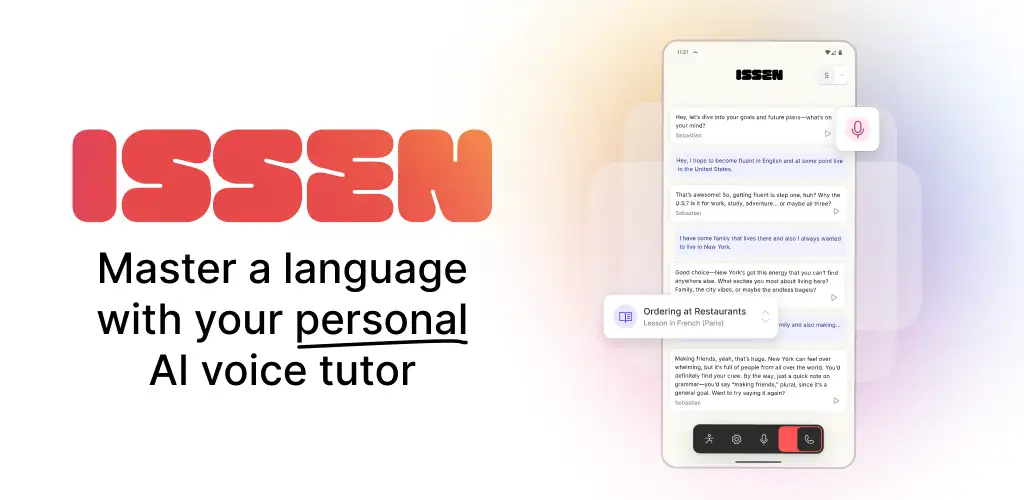
Every scenario above runs inside ISSEN as a full spoken conversation. Paste the roleplay prompt, hit start, and you are in a live business meeting in under 30 seconds. Custom scenarios let you script the exact setup line by line: role, register, pushback level, interruption rules.
Three features matter for professional practice. Smart turn detection means no push-to-talk, so the tutor interrupts and lets itself be interrupted the way a real colleague would. AI language tutoring for speaking fluency relies heavily on this kind of adaptation: cross-session memory keeps track of the structures you fumbled last week and works them back into this week's roleplay. Conversation-anchored flashcards surface the words you actually used, tied to the sentence you used them in.
ISSEN runs on iOS, Android, and web for $20 to $29 USD per month (verify current pricing on issen.com), well below a single italki or Preply session.
Try ISSEN free for 10 minutes.
Final thoughts on practicing English for real business conversations
Your reading and writing may be at B2, but the moment your manager asks for your view in a live call, that is where the gap shows up. Targeted roleplay on the specific scenarios you face at work is what closes it, and ten focused minutes a day builds the retrieval speed that courses alone cannot. Try ISSEN free for 10 minutes and run one of these scenarios before your next meeting.
FAQs
What's the difference between using ISSEN and Preply or italki to practice English for business meetings?
ISSEN gives you unlimited on-demand speaking reps at under $1 per session at daily use, while Preply and italki sessions run $20 to $50 each and require scheduling in advance. The practical split is this: use a human tutor on Preply or italki for periodic cultural correction and structured accountability, and use ISSEN for the daily volume that weekly sessions cannot supply.
Can I practice specific business English scenarios like salary negotiations or client escalations with an AI tutor?
Yes. You can paste a custom roleplay prompt directly into ISSEN, specifying the role, register, pushback level, and interruption rules, and be in a live spoken conversation within 30 seconds. The scenario library in the blog includes ready-to-use prompts for negotiations, performance reviews, standups, and deal-closing at B1 through C1 level.
Is AI roleplay a replacement for a business English course?
The two cover different gaps, so neither replaces the other. A course builds declarative knowledge: report structures, email registers, formal grammar. AI roleplay builds retrieval under pressure, which is the gap Swain's Output Hypothesis identifies as what classroom hours rarely close when 12 learners share one session. Use the course for structure and AI roleplay for the speaking volume that converts knowledge into automatic speech.
What CEFR level do you need to lead a business meeting in English?
Leading a meeting comfortably sits at B2, where you can present results and run a client call without a script. Chairing high-stakes meetings or negotiating contracts requires C1, where register-shifting mid-conversation becomes reliable. If you can follow a meeting but freeze when asked for your view, you are likely at B1 reaching for B2, which is the exact plateau where structured roleplay practice produces the fastest gains.
How do you set up a job interview roleplay with an AI voice tutor that actually prepares you for unpredictable questions?
Give the tutor a one-line scene with explicit constraints: role, seniority level, language difficulty, time limits, and an instruction to add an unexpected follow-up question. The unpredictability matters because scripted prep tools let you rehearse polished answers to expected questions, while open-ended AI response forces you to produce language you have not pre-loaded, and that is precisely the pressure that surfaces gaps in real-time retrieval.