
How to Practice Slang, Dialects, and Real-Life Scenarios With AI (August 2026)
Textbooks teach you the Spanish that nobody actually speaks at home. You study the clean, standard version and then someone in Osaka hits you with Kansai-ben, or a Santiago cab driver starts throwing in "cachai" and "po" and you're nodding along understanding maybe half of it. Getting comfortable with local dialects means practicing them under real conversational pressure, beyond reading a vocabulary list at the back of a chapter.
TLDR:
- Textbooks teach standardized registers locals rarely use; the real gap shows up in lexicon, contracted speech, and register cues like filler words and sentence-final particles.
- Roleplay scenarios convert passive vocabulary into active speech because retrieval under pressure forces you to notice gaps, which is the core mechanism Swain's Output Hypothesis identifies as driving acquisition.
- A 2025 systematic review of 44 shadowing studies found the practice can improve comprehensibility, intelligibility, and prosody in second-language learners, making it the most direct method for accent work.
- Pick your dialect variant based on where you'll actually speak, then commit to it; most AI tutors are session-scoped on dialect, so register changes within a single variant are easier to request than full dialect swaps.
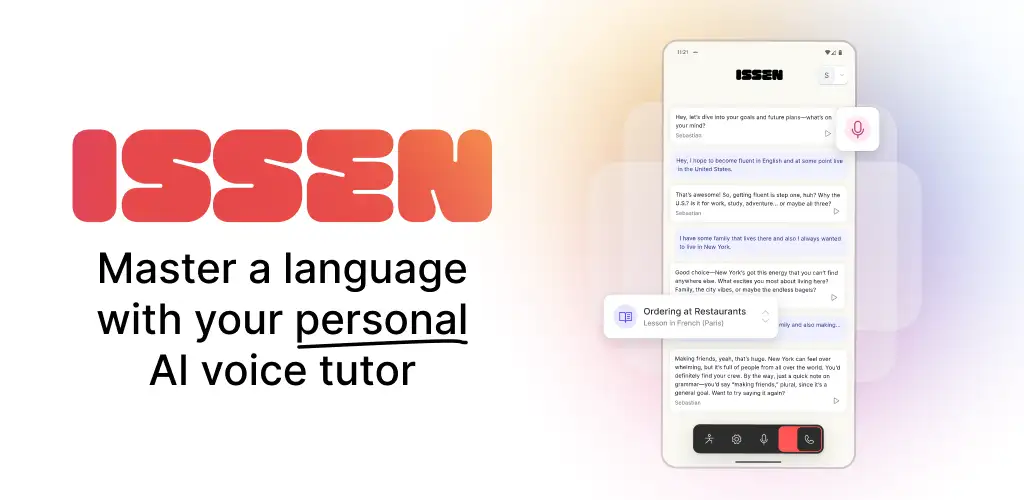
- ISSEN is a real-time AI voice tutor covering 60+ languages with regional accent options including Argentina, Mexico, and Spain for Spanish; Shadowing runs as a separate dedicated mode, so pronunciation drills stay separate from live conversation practice.
Can AI teach you slang and regional dialects?
Yes. A well-designed AI voice tutor can teach regional slang and dialects by generating dialogue in a chosen variant, adjusting vocabulary on the fly, and pushing you to produce informal phrasing under real-time conversational pressure. Retrieval under pressure is what turns recognized slang into spoken slang.
The mechanism has three parts. The tutor picks a target variant (say, Rioplatense Spanish or Kansai-ben Japanese) and stays inside its lexicon, intonation cues, and idiomatic patterns. It adapts phrasing to your level so slang lands in your comprehensible range instead of flying past you. And because responses come back in seconds, you rehearse the informal register the way you'd actually use it, not the way a textbook lists it in the back matter.
What's the difference between textbook language and how locals actually speak?
Textbooks teach a standardized register almost nobody speaks at home. You study Spanish with an AI voice tutor and land in Buenos Aires where everyone says "vos tenés" and drops "che" into every third sentence. You memorize Parisian vowels and a Montreal cashier greets you in joual, swallowing syllables. You drill polite Tokyo Japanese and Osaka hits you with Kansai-ben, softening copulas ("ya" for "da") in ways your textbook flagged as footnotes.
The gap shows up in three places at once:
- Lexicon: local words replace the textbook item (Argentine "quilombo" for a mess, Quebecois "char" for a car).
- Contractions: fast speech collapses syllables that written grammar keeps whole.
- Register cues: sentence-ending particles, softeners, and filler words that mark you as inside or outside the group.
Formal study builds the scaffolding; locals speak from a different floor plan, and the gap between the two is where fluency actually forms.
Which dialect variant should you learn?
Pick the variant tied to where you'll actually speak: the city you're moving to, the family you married into, the client you take calls from. Choose once, then commit.
Variant | Region | Example words and phrases | Meaning |
|---|---|---|---|
Buenos Aires, Montevideo | che, boludo, quilombo, laburo | hey, dude, a mess, work | |
Castilian Spanish | Spain (most regions) | vale, tio, guay, molar | okay, dude, cool, to like |
Mexican Spanish | Mexico | wey, chido, no manches, ahorita | dude, cool, no way, in a bit |
Chilean Spanish | Chile | cachai, weon, po, bacan | you get it, dude, filler, awesome |
Andalusian Spanish | Southern Spain | miarma, quillo, ea, illo | my soul, kid, yeah, hey kid |
Quebecois French | Quebec | char, tabarnak, chum, magasiner | car, damn, friend/boyfriend, to shop |
Parisian French | Paris | mec, ouais, kiffer, bouffer | dude, yeah, to love, to eat |
Swiss German | German-speaking Switzerland | gruezi, merci vilmal, znuni, velo | hello, thanks a lot, morning snack, bike |
High German | Germany, Austria | Guten Tag, quatschen, Kumpel, Feierabend | good day, to chat, buddy, end of workday |
Kansai Japanese | Osaka, Kyoto | ookini, akan, honma, nanbo | thanks, no good, really, how much |
Tokyo Japanese | Kanto region | arigatou, dame, hontou, ikura | thanks, no good, really, how much |
How roleplay scenarios build real conversation skills
Scenarios beat drills because they force retrieval under pressure. When you're haggling over a leather jacket in a Santiago market using one of the best AI Spanish conversation apps, your brain has to pull the right filler, verb form, and register at once, in the second the shopkeeper stops talking. That production pressure is what Swain's Output Hypothesis identifies as the missing ingredient in input-heavy study: producing language forces you to notice gaps your reading brain glides over, and noticing is what converts passive recognition into active speech (Swain's Output Hypothesis).
Scenarios worth requesting from an AI tutor:
- Ordering at a corner spot where the menu is verbal and the server is impatient.
- Negotiating rent with a landlord over WhatsApp voice notes.
- A job interview where small talk precedes the real questions.
- Meeting your partner's parents for the first time.
- Handling a taxi driver who takes the long way.
- Complaining to customer service without escalating.
Each scenario locks a slice of slang and register into a memorable frame.
How do you practice regional accents with an AI tutor in 2026?
Regional accents live in rhythm, stress, and vowel shape more than vocabulary. The shadowing pronunciation technique trains those elements: you listen to a native speaker, then repeat their line at the same speed, copying intonation as closely as you can. A 2025 systematic review of 44 shadowing studies found the practice can improve comprehensibility, intelligibility, and prosody in second-language learners.
Shadowing feels exposing at first. You hear your own voice miss the mark and want to stop. AI tutors lower that anxiety barrier by removing the social audience, which research on AI chatbots for speaking identifies as a real driver of engagement and confidence gains.
A workable weekly loop:
- Pick a 30 to 60 second clip of a native speaker in your target dialect, the kind of material covered by AI tutors for accent training, whether that is Porteño Spanish from Buenos Aires or Kansai Japanese from Osaka.
- Shadow it five times, matching pace and stress placement without pausing to translate.
- Record yourself once and compare against the original, listening for vowel length and intonation contour.
- Carry three phrases from the clip into your next AI conversation and use them out loud in context.
Shadowing in ISSEN sits in its own dedicated mode, separate from voice conversations, so you can drill pronunciation without derailing a dialogue.
Can an AI tutor switch between dialects mid-conversation?
Partly. In our testing, full dialect swaps mid-session (Rioplatense to Chilean, Kansai to Tokyo) tend to be session-scoped, because the tutor loads a voice and lexical profile at the start and drifts back to it under conversational load. Check your app's settings before starting to confirm whether mid-session switching is supported; if not, restart with the target variant selected.
Register shifting inside a single dialect is easier to request. Ask your tutor to open in Tokyo keigo for a mock client call, the kind of session reviewed in AI vs. human tutor language speaking comparisons, then drop into casual speech ("da" for "desu," "yabai" as an intensifier, sentence-final "yo" and "ne") once you're grabbing drinks with the same colleague. Same for Spanish: business Castilian for the interview, informal Andalusian phrasing ("quillo," dropped syllable endings) for the drink after.
Name the register, and give the tutor a scene change to anchor it.
How AI tutors compare for slang and dialect support in 2026
Cross-check each cell before you subscribe. Feature scopes shift between app updates, and free tiers gain or lose capabilities without notice.
App | Choose a regional variant | Custom scenario roleplay | Mid-session language mixing | Correction of register (formal vs. street) |
|---|---|---|---|---|
ISSEN | Yes (Argentina, Mexico, Spain, British, American, Australian, Kansai, Tokyo, and more) | Yes | Yes (Spanglish and other mixed input supported) | Yes, on request |
Pingo | Verify on live site | Yes (roleplay and tutor modes across 25+ languages) | Verify on live site | Verify on live site |
LanguaTalk (Langua) | Yes (Colombian, Peruvian, Chilean, Uruguayan Spanish confirmed) | Yes | Verify on live site | Verify on live site |
TalkPal | Roadmap item, not confirmed shipped | Yes (300+ scenarios across 130+ languages with cultural context) | Verify on live site | Verify on live site |
Duolingo | Verify on live site | Roleplay gated to Max tier | Verify on live site | Verify on live site |
Babbel | Verify on live site | Verify on live site | Verify on live site | Verify on live site |
Two patterns worth naming. Roleplay coverage is broad, but regional variant selection is uneven (see the full breakdown of best AI language tutors for conversation practice), so pick the app whose confirmed variants match the city you're speaking in. Mixed-language input (throwing an English word into a Spanish sentence when you blank) is rare outside ISSEN, which matters if your speech drifts across languages under real conversational load.
ISSEN: practice slang, dialects, and real-life scenarios across 60+ languages
Everything above describes what a well-designed AI voice tutor can do. Here is what ISSEN does in practice.
ISSEN is a real-time AI voice tutor covering 60+ languages, with regional accent options including Rioplatense, Mexican, and Castilian Spanish, alongside British, American, and Australian English. Shadowing is a separate mode for pronunciation drills across those accents, so you can pause and repeat lines without breaking a live conversation.
Inside voice conversations, a few things matter for slang work:
- Smart turn detection means no push-to-talk. You speak, the tutor responds, the exchange feels like a phone call.
- Mixed-language input is supported. Drop an English word into a Spanish sentence when you blank and the tutor keeps going.
- Cross-session memory holds onto the dialect vocabulary you fumbled last week and resurfaces it in a new scene, which is a core feature of personalized language learning apps that adapt to you.
- Custom scenario roleplay lets you set the situation (a Buenos Aires street market, a Berlin flat viewing, an Osaka izakaya) and start speaking in that register from the first line, a pattern consistent with AI apps for real language conversations reviewed independently.
Practice your first conversation with an ISSEN tutor.
Final thoughts on learning local slang and dialects through AI conversation practice
The version of Spanish or French or Japanese your textbook taught you was never what people speak at home, at the market, or over drinks after work. Getting comfortable with the real version means hearing it, producing it under pressure, and building enough reps that the filler words and dropped syllables come out without thinking. Roleplay scenarios with a dialect-matched tutor are the fastest way to build those reps without needing a plane ticket first. Start your first ISSEN conversation and start closing the gap between the language you studied and the language people actually speak.
Think about Camila, a product manager in Medellín who just joined a Buenos Aires-based team. She reads Rioplatense Spanish without much trouble but freezes the moment a colleague drops “boludo” into a fast-moving standup. Over the next two to five years, dialect-aware AI tutors will do what no textbook chapter can: they'll know Camila is already comfortable with formal registers and push her directly into Porteño slang, tracking which words she stumbles on across sessions and resurfacing them in the next scenario she runs. The accent work stays separate, handled in a dedicated shadowing mode, while her live conversations get progressively less scripted. What she’s building toward is the ability to land a joke in the right register on a Tuesday call and have her teammates actually laugh.
FAQs
What's the fastest way to practice local slang and dialects with an AI tutor?
Pick a specific variant before your session starts (Rioplatense Spanish, Kansai Japanese, Quebecois French) and request a scenario tied to real life in that place, such as a market haggle or a flat viewing. The scenario forces you to pull informal phrasing under conversational pressure, which is what moves slang from passive recognition into active speech. ISSEN supports regional variant selection across 60+ languages and lets you set the scene from the first line.
Can I practice roleplay AI scenarios in a specific dialect, or does the tutor revert to standard speech?
Most AI tutors load a lexical and voice profile at session start and drift back toward a standard register under conversational load, so full dialect consistency works best when you select the variant before opening a conversation instead of switching mid-session. Register changes within a single dialect, say Tokyo keigo for a mock client call dropping into casual speech for drinks after, are easier to request by giving the tutor a named scene change as the anchor.
How do you practice regional accents with an AI tutor?
Shadow a 30-60 second clip of a native speaker in your target dialect five times, matching pace and stress without pausing to translate, then carry three phrases from that clip into a live AI conversation and use them in context. A 2025 systematic review of 44 shadowing studies found the practice improves comprehensibility, intelligibility, and prosody in second-language learners. In ISSEN, shadowing runs in its own dedicated mode separate from voice conversations, so pronunciation drills stay structurally distinct from live dialogue.
ISSEN vs Duolingo for practicing slang and real-life dialect scenarios?
ISSEN gives you open-ended conversation in a chosen regional variant from the first session, with mixed-language input supported and no push-to-talk mechanics. Duolingo's roleplay feature is gated to the Max tier and covers guided, predictable scenarios instead of open real-time exchange, and regional dialect selection is not a confirmed feature. If your goal is producing informal speech under real conversational pressure, the two products are solving different problems.
Why does textbook Spanish leave you unprepared for how locals actually speak?
Textbooks teach a standardized register built for comprehensibility across all regions, which means local vocabulary, contracted syllables, and register markers get flattened out or relegated to footnotes. When you land in Buenos Aires and hear "vos tenés" and "che" in every sentence, or in Osaka and hit "ookini" and softened copulas, your textbook has given you the scaffolding but not the floor plan locals speak from. Closing that gap requires producing the informal register under real conversational pressure, not reading about it in the back matter.