
How to Learn a Language While Commuting (August 2026)
Twenty minutes a day of the right kind of practice beats two hours on a Saturday that you forget by Wednesday, and most people already have those 20 minutes baked into their day. The tricky part is that learning a language while commuting means something different depending on whether you're behind the wheel, on foot, or on a train. Each mode has its own constraints, and working with them instead of against them is what makes daily reps stick.
TLDR:
- Your average round-trip commute adds up to roughly 45 hours of monthly practice time you're currently not using for language learning.
- Twenty minutes daily beats two hours on Saturday because a meta-analysis of 48 spacing experiments found spaced practice produces measurably better delayed retention than massed study sessions.
- Walking gives you the most productive reps since your hands and eyes are free; a 2014 Goethe University Frankfurt study found vocabulary encoded during light walking outperformed seated study.
- Most apps marketed as commute-friendly fail the two real tests: lock-screen playback and advancing without a tap. Most apps in the comparison table below fail one or both.
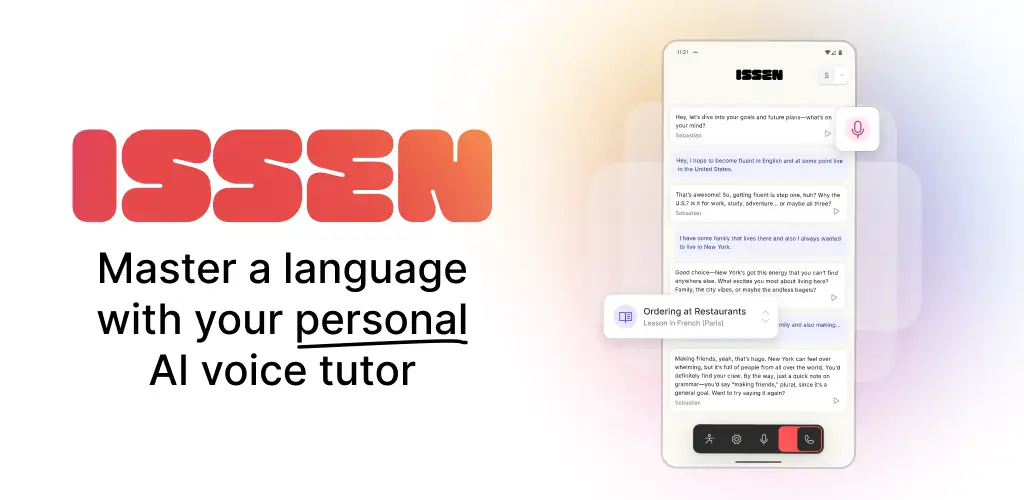
- ISSEN's AI voice tutor runs in background mode with smart turn detection across 60+ languages, making it one of the few options that works while your phone stays in your pocket.
Your commute is already a language classroom
The average one-way commute in the United States runs 27.2 minutes, which adds up to roughly 45 hours a month for a round-trip five-day week. Most of that time gets spent half-listening to a podcast or watching brake lights.
Speaking and listening are ears-and-mouth skills. They do not need a screen or a desk. That makes commutes well-suited for the part of language learning traditional study leaves underdeveloped, which is why AI language apps for busy adults have focused on audio-first formats.: producing sound out loud and processing it in real time.
Walking, driving, and transit each carry different constraints, and the rest of this piece works through them one by one.
Can you learn a language while driving?
Yes, driving is one of the oldest ways adults have picked up languages outside a classroom. The catch is that only listening-based methods work safely behind the wheel: audio lessons, native dialogue tracks, and spoken repetition drills that ask nothing of your eyes or hands.
This lines up with Krashen's input hypothesis, which holds that acquisition happens when you take in language slightly above your current level in meaningful context. A dialogue between two native speakers about renting an apartment counts. A grammar exercise on your phone does not.
What actually works in the car:
- Graded audio lessons where a host prompts you to repeat phrases aloud
- Native-speaker podcasts pitched at your level or one notch above
- Audiobooks you have already read in translation, so the plot carries you through unfamiliar words
- Shadowing short lines from a track you have heard before
What does not work: tapping through flashcards, reading subtitles, and any grammar drill that assumes you can look at a screen.
How many minutes of commuting per day is enough?
Twenty minutes a day, five days a week, is enough to make measurable progress. That gives you about 100 minutes of weekly exposure, and a 30-minute one-way ride puts you in the 150 to 250 minute range most self-taught learners maintain long term.
Daily beats weekly because of spacing. A meta-analysis of 48 spacing experiments found medium-to-large benefits for spaced review over massed practice, especially for delayed retention. Two hours on Saturday feels productive and evaporates by Wednesday. Twenty minutes Monday through Friday builds the retrieval loops that stick.
Start with the commute you already have. You do not need to add time to your day.
Is it safe to practice speaking while driving?
Speaking out loud while driving is a gray zone worth taking seriously. The CDC groups distracted driving into three types: visual, manual, and cognitive. Cognitive load still pulls attention off the road even when your hands are free.
The practical rule:
- Passive listening to audio courses, podcasts, or dialogue tracks is fine while driving.
- Repeating a short phrase after a prompt works on an empty highway, not in city traffic.
- Full conversation practice or sentence construction belongs on walks, transit rides, or a parked car before you pull out.
Hands-free still carries cognitive load. Save the harder reps for moments your eyes are not doing safety work.
What is the best way to practice a language while walking?
Walking is the strongest commute mode for active practice because your mouth and ears are free while your hands and eyes stay engaged with the sidewalk. A 2014 study at Goethe University Frankfurt found that adults who encoded vocabulary during light treadmill walking outperformed those who studied seated.
That opens room for harder reps a car ride cannot support:
- Shadowing native audio out loud, matching rhythm and stress as you step
- Full voice conversations through earbuds with an AI voice tutor
- Podcast episodes where you pause and repeat lines back
- Narrating what you see around you in the target language
A 25-minute walk handles a full session end to end.
How do you learn a language hands-free without looking at your phone?
The setup takes about five minutes the first time and zero after that. Do it once at home, and every commute after runs without you touching your phone.
- Pre-load audio the night before. Download podcast episodes, audiobook chapters, or lesson tracks so nothing buffers on cellular or drops in a tunnel.
- Pair Bluetooth earbuds you can control by touch. Play, pause, and skip should live on the earbud, not the screen.
- Turn on lock-screen playback. If a session pauses when your phone locks, it fails the commute test.
- Pick tools that advance without taps. Audio courses and voice tutors that run in the background belong in the rotation. Flashcard apps that require swiping do not.
Seated transit riders get one bonus: a subway ride lets you add a transcript or saved sentence list without any safety tradeoff. Standing on a crowded train, keep your eyes up and treat it like a walking session.
What to listen to: audio formats ranked by commute value
Match the format to your level and where you are. A quick ranked view:
Format | Best for | Commute mode |
|---|---|---|
Structured audio courses (Pimsleur, Language Transfer) | A0 to A2 beginners | Driving, walking, transit |
Native dialogue recordings for learners | A2 to B1 | Driving, walking, transit |
Learner podcasts with graded input | A2 to B1 | Driving, walking, transit |
Native news, interviews, and audiobooks | B1 and up | Driving, walking, transit |
Live AI voice conversation | Any level with productive intent | Walking or parked only |
The higher the production demand, the more your eyes and hands need to be free. Save live conversation for the sidewalk.
How to build a consistent language learning habit long term
The commute itself is the trigger. You do not decide to practice, you start the session when you start the walk or the engine. Habit stacking works because it removes the daily choice.
A few anchors:
- Set a minimum viable session of 10 minutes. If that is all you have, it still counts.
- Track spoken output minutes, not streaks or lessons finished. Streaks reward opening an app; minutes reward using your mouth, which is why speaking practice in your language routine deserves its own dedicated slot.
- Match the mode to the day, and when you miss one, move on without renegotiating the whole plan. Driving days lean listening, walking days lean speaking, transit days handle either.
Hands-free language app comparison 2026
Not every app that markets voice practice actually works when your phone is in your pocket; a broader look at language learning apps with AI voice shows how wide the gap is. The table below measures six apps against four commute-specific criteria. Verify current capabilities on each app's store listing before subscribing.
The two questions that matter most for a real commute are lock-screen playback and whether the app moves forward without a tap. Most best language learning apps for speaking still fail one or both.App Runs with screen locked Advances without tapping Passive listening mode Voice-only sessions ISSEN Yes Yes Yes Yes Duolingo No No Limited (Stories audio) Max tier only Speak No No Yes (lessons) Push-to-talk Pingo Partial No Limited Push-to-talk Memrise No No Yes (Immerse videos) No Babbel No No Yes (Babbel Live audio) No ISSEN: AI voice tutoring built for the commute
The commute is where a voice tutor earns its keep, and that gap is exactly what ISSEN was built to fill. The app runs with your screen locked in background mode, so a walking session continues while your phone stays in your pocket. Smart turn detection removes the push-to-talk button: you speak, the tutor waits, then responds. That is a core feature of how AI speaking practice works at its best.A few specifics that matter on a sidewalk or a train:- The tutor drives the conversation from the start, so you never have to invent a prompt at a crosswalk.
- Difficulty adjusts in real time, holding vocabulary and pace at your level within a single turn.
- Memory carries across sessions. Tuesday's walk picks up from Monday's bus ride without rebuilding context.
- 60+ languages supported, with flat pricing of $20 to $29 USD per month and unlimited daily practice.
Final thoughts on using your commute to learn a language
The 27-minute average commute is not a constraint on language learning. For most self-taught learners, it covers the daily minimum. Driving gets you the input, walking gets you the output, and transit handles whichever one you skipped. Build the habit around the commute you already have, not the study schedule you keep meaning to start. Try ISSEN free for 10 minutes on your next walk.FAQs
Can you really learn a language while commuting, or does it only work for passive listening?
You can build real productive skills during a commute, but the method has to match the mode. Driving limits you to listening-based practice: audio courses, native dialogue tracks, shadowing short phrases. Walking frees your mouth for full voice conversations, including live back-and-forth with an AI tutor like ISSEN.How much commute time per week do you actually need to make progress in a language?
Twenty minutes a day, five days a week, is enough to see measurable gains. A meta-analysis of 48 spacing experiments found medium-to-large retention benefits for distributed practice over massed sessions, which means five short commutes beat one long Saturday study block for building the retrieval loops that stick.Is it safe to practice speaking out loud while driving?
Passive listening is fine behind the wheel, but full conversation practice carries real cognitive load. The CDC categorizes cognitive distraction as one of three types of distracted driving, and that load does not disappear when your hands are free. Save sentence construction and live AI conversations for your walk, transit ride, or a parked car before you pull out.Pimsleur vs ISSEN for commute-based language learning?
Pimsleur is purpose-built for audio repetition and works well on drives at A0 to B1, but the format is fixed and cannot respond to you. ISSEN runs in background mode with smart turn detection, so a walking commute becomes a live two-way conversation instead of a prompted drill. That is the difference between rehearsing lines and actually speaking under pressure.How do I set up a language learning app to run hands-free during my commute?
Do the setup once at home the night before: download audio or lesson content offline, pair Bluetooth earbuds with touch controls, and confirm the app continues from the lock screen. Most speaking apps fail that last test. They pause when your screen locks, which breaks a walking or transit session the moment your phone goes to sleep.