
How Long Does It Take to Learn French? (And How AI Cuts That Time in June 2026)

The Foreign Service Institute says French takes 600 to 750 hours to reach working proficiency. That number is honest, and it holds whether you spread those hours across two years or five. What changes how long it takes to learn French is the ratio of speaking hours to passive ones. A learner banking five real conversation hours a week will pass a learner banking ten hours of app scrolling, every time. An AI voice tutor makes those five speaking hours easier to find.
TLDR:
- French takes 600 to 750 hours to reach B2, where you can work and watch films without subtitles.
- Most learners spend 90% of study time on passive reading and 10% speaking aloud.
- Traditional methods plateau at A2 to B1 because apps reward streaks over real conversation reps.
- ISSEN provides daily voice practice across Parisian, Quebecois, and Belgian French dialects.
- Five to seven hours a week focused on speaking output beats ten hours of app scrolling.
Introduction
Will French take you six months or six years? The honest answer depends on how you study and how much you speak. The US State Department's Foreign Service Institute classifies French as a Category I language, meaning English speakers reach professional working proficiency in roughly 24 to 30 weeks of full-time study, or 552 to 690 classroom hours.
That figure assumes a classroom, a teacher, and a full-time schedule. Most adults have none of those. They have a commute, a job, and maybe 30 minutes before bed. An AI voice tutor changes the math on speaking practice, which is where most learners lose the most time.
The Honest Answer: How Long French Really Takes
The 600 to 750 hour range from the FSI is the working number most French teachers cite. It converts cleanly into weeks and months once you know how much time you can give it.
Three commitment levels cover most adult learners:
- Casual: 3 to 5 hours a week. Evenings, weekends, a podcast on the commute.
- Committed: 8 to 10 hours a week. Daily practice plus one or two longer sessions.
- Intensive: 20+ hours a week. Closer to a full-time class or immersion stay.
Most learners reach B2, a comfortable intermediate level, within 6 to 24 months of consistent work.
What Makes French Easy or Hard for English Speakers
French sits in the FSI's easiest tier for English speakers for a reason. After the Norman Conquest in 1066, English absorbed thousands of French words, which is why "restaurant," "government," and "important" look nearly identical in both languages.
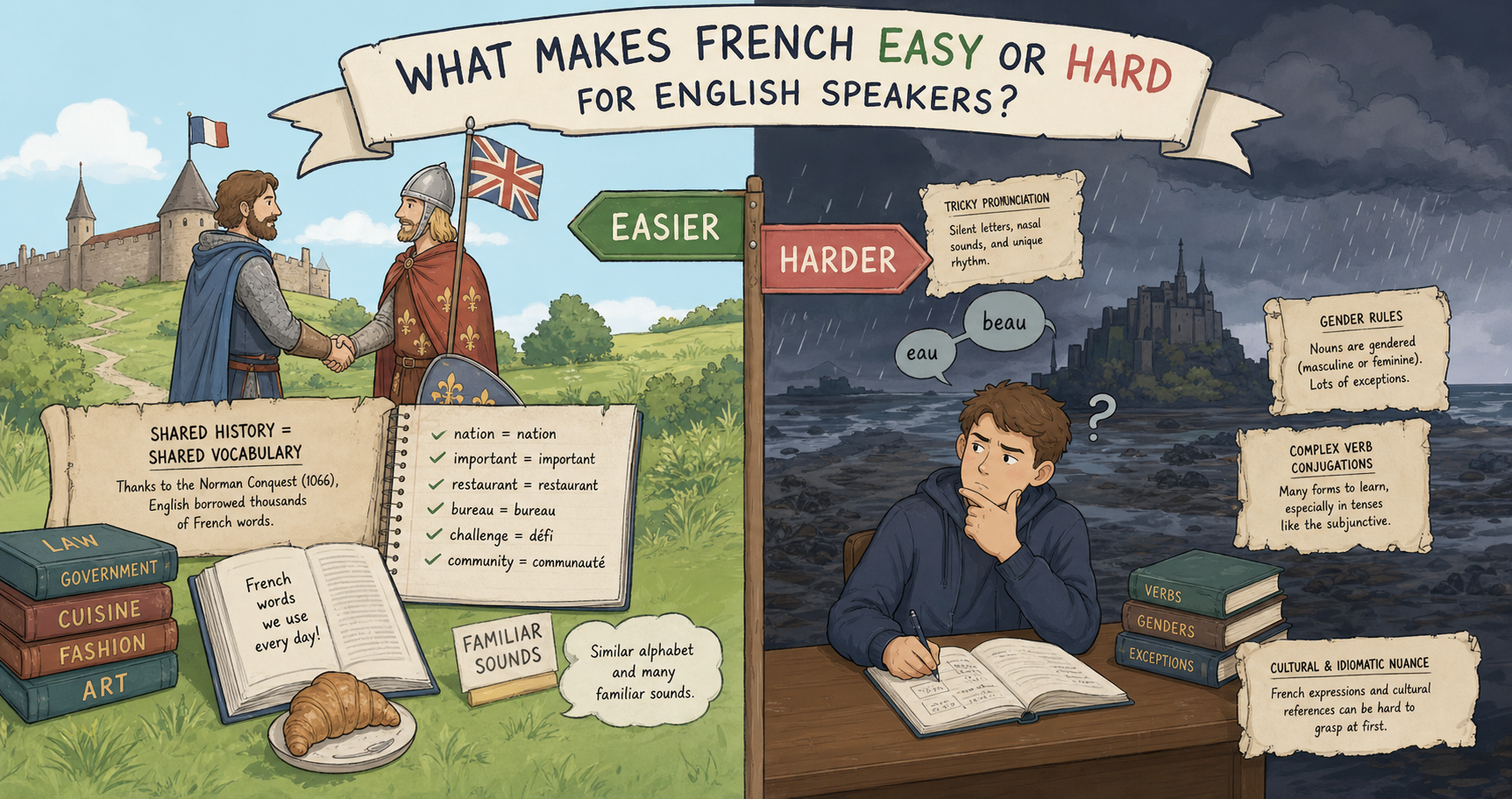
The friction shows up elsewhere.
- Gender is arbitrary. "Le livre" is masculine, "la table" feminine. You memorize the article with the noun or guess wrong forever.
- Verb conjugation is heavy. "Parler" has around 40 distinct forms across tenses and moods, and irregulars (être, avoir, aller, faire) carry most conversations.
- Liaison and elision fuse words together. "Vous avez" sounds like "voo-zah-vay." The page and the spoken word stop matching.
- Casual speech drops sounds. "Il ne sait pas" becomes "i sais pas." The textbook version barely exists in the wild.
The reading-to-speaking gap is wider in French than in most languages an English speaker will try.
Fluency Milestones: What Each Stage Actually Looks Like
Each CEFR level marks a clear shift in what you can actually do in French. The hour ranges below come from langmitra's French proficiency roadmap and align with the FSI numbers above.
Level | Hours | What you can do | Example |
|---|---|---|---|
A1 | 60 to 100 | Introduce yourself, order coffee, ask directions | "Je voudrais un cafe, s'il vous plait." |
A2 | 150 to 200 | Discuss weekend plans, describe your job | "Ce weekend, je vais voir mes parents a Lyon." |
B1 | 400 to 550 | Hold a real conversation, follow slow news | "Je trouve que le teletravail a change mon equilibre vie-travail." |
B2 | 600 to 800 | Follow a film without subtitles, work in French | "Si j'avais su que la reunion serait annulee, je ne serais pas venu." |
C1 | 800 to 1,100 | Read literature, catch humor and irony | "Ses arguments manquent singulierement de nuance." |
C2 | 1,000+ | Operate like an educated native speaker | "L'ambiguite de sa formulation laisse entrevoir une intention dissimulee." |
B2 is the level most adult learners actually need. You can work, date, argue with a landlord, and watch a film without subtitles. Above that, you're polishing.
Why Traditional Methods Take So Long
The bottleneck is almost always the same: you build a thick pile of passive vocabulary, then freeze the moment a conversation starts. Producing "Si j'avais su" out loud while a waiter waits, with clean liaison and the right intonation, requires practice that reading alone doesn't provide.
French punishes the gap harder than most. Natives run at around 7 syllables per second, drop the "ne" in negations, and glue words together with liaison. Conjugating "avoir" automatically under pressure takes hundreds of hours of speaking, not reading.
Gamified apps make this worse. A Duolingo French review notes most learners plateau at A2 to B1, because the app rewards streaks over time spent producing French aloud. For more insights on language learning methods, check out the ISSEN Blog.
How AI Tutoring Compresses the Timeline
The hours don't shrink. The wasted ones do. A traditional learner spends most of their study time reading, watching, and reviewing flashcards, with maybe 10 percent of total study hours actually producing French aloud. Flip that ratio and the calendar collapses.
A real-time voice tutor combines three things classrooms struggle to. Swain's Output Hypothesis (1985) frames speaking as the moment you notice the gap between what you mean and what you can say. Krashen's comprehensible input principle says the material has to sit just above your level. Add corrective feedback inside the same loop and you have the conditions research points to as the fastest path.
For French in particular, that looks like:
- Drilling "avoir" and "etre" conjugations inside a story you care about, not a table.
- Producing liaison at conversational speed, then slowed down, then sped up again.
- Repeating "la voiture" and "le probleme" until the article fires automatically with the noun.
With an ISSEN tutor, you can run Parisian French at 7 a.m., switch to Quebecois on an evening walk, and try a Belgian accent on the weekend. The hours stay roughly the same. More of them are spent talking.
A Realistic Schedule to Reach Conversational French Faster
Five to seven hours a week built around output will move you faster than ten hours of passive app time. Make the speaking non-negotiable and let lighter inputs fill the gaps.
The 30-minute voice block is the anchor; everything else feeds it. Spanish speakers can find tutoring options in their native language. Flashcards work best when the card surfaces a sentence you actually used, which is what Cambridge's guidance on flashcards with example sentences points to. Skip a day, resume the next.
Common Mistakes That Slow Learners Down
Six patterns slow French learners down more than anything else. Each has a fix you can apply this week.
- Avoiding speaking out of fear. Reading feels productive while your mouth still freezes. Fix: book a daily 20-minute voice session before any passive study.
- Translating word by word from English. French word order, gender, and prepositions diverge too often. Fix: learn chunks ("il y a," "ça me dit") as single units.
- Ignoring pronunciation early. Bad habits with nasal vowels and the French "r" calcify fast. Fix: shadow short clips from week one.
- Practicing listening only at slowed speed. Podcasts at 0.75x train a French that doesn't exist. Fix: listen at full speed first.
- Skipping conjugation drills. Recognizing "j'aurais" on a page doesn't mean you can produce it. Fix: drill the top 20 irregulars out loud across present, passé composé, imparfait, and conditionnel.
- Treating all French as Parisian. Quebec, Belgium, and West Africa have distinct pronunciation. Fix: pick the dialect that matches your goal.
FAQ
Can I become fluent in French in 3, 6, or 12 months?
Fluent means different things at A2, B1, and B2. Three months of intensive study (20+ hours a week) can land you at A2 or low B1. Twelve months at 8 to 10 hours a week, weighted toward speaking, can reach a solid B2.
Is French harder than Spanish or Italian?
All three sit in FSI Category I. French pronunciation, nasal vowels, and liaison make listening harder for English speakers than Spanish, while grammar load stays roughly comparable across the Romance family.
Do I need to live in France to become fluent?
No. A study-abroad meta-analysis found medium-to-large effects from immersion, driven by interactive input instead of location. Daily voice conversations and French media at full speed replicate most of the benefit.
How much does it cost to reach fluency in French?
A human iTalki or Preply tutor runs $15 to $40 USD an hour. At 200 speaking hours to B2, that's $3,000 to $8,000. An AI voice tutor at $20 to $29 USD a month puts the same 200 hours at a few hundred dollars.
Can AI replace a human tutor for French?
Treat AI as a complement. An ISSEN tutor handles the unlimited daily reps: conjugation drilling, dialect switching, conversation at 6 a.m. or midnight. A human teacher still adds cultural nuance and the pressure of a scheduled session.
Conclusion
The FSI puts French at 600 to 750 hours for working proficiency, and that number holds whether you spread it across two years or five. What changes the calendar is the ratio of speaking hours to passive ones. A learner banking five real conversation hours a week will pass a learner banking ten hours of app scrolling, every time.
Pick a weekly speaking target you can actually hit. Block it before anything else lands on the calendar. A 10-minute free trial with an ISSEN tutor is enough to find out what a daily speaking rep in French feels like, and to start counting hours that move you toward B2 instead of around it.
Final Thoughts on the Path to French Fluency
You can read about subjunctive conjugations for a year and still freeze when a waiter asks a follow-up question, or you can spend that same year producing French aloud and arrive at B2 with the muscle memory to back it up. The bottleneck has always been moving from recognition to automatic production under pressure. ISSEN compresses that gap by giving you unlimited daily reps with real-time correction, no scheduling, and no small talk before the lesson starts. Block 30 minutes a day, start the free trial, and see what consistent speaking time does to the timeline.