
Why You Should Speak Your Target Language From Day One July 2026
If your speaking practice has mostly meant waiting until you know enough, you're training the wrong thing. Understanding a language and producing it in real time use different mental pathways, and the production one only develops through use. There's a well-documented reason why output practice speaking accelerates fluency in ways that reading and listening alone never quite reach.
TLDR:
- Swain's Output Hypothesis (1985) explains why years of listening and reading leave speaking untrained: comprehension and production use separate cognitive pathways, and only speaking drills the one you actually need.
- Delaying output compounds the problem; every avoided conversation reinforces speaking anxiety by giving avoidance more practice than production gets.
- The input-output ratio should shift as you advance: at B1 and above, retrieval speed is the bottleneck, and that means output should match or exceed input time.
- Layer practice from low-stakes to high: internal narration and self-recording build raw material, while real conversation with a tutor or partner is where that material becomes speech.
- A 2024 review of AI chatbots for speaking practice found gains in anxiety reduction, confidence, and speaking outcomes, making AI voice practice a practical starting point before adding human partners.
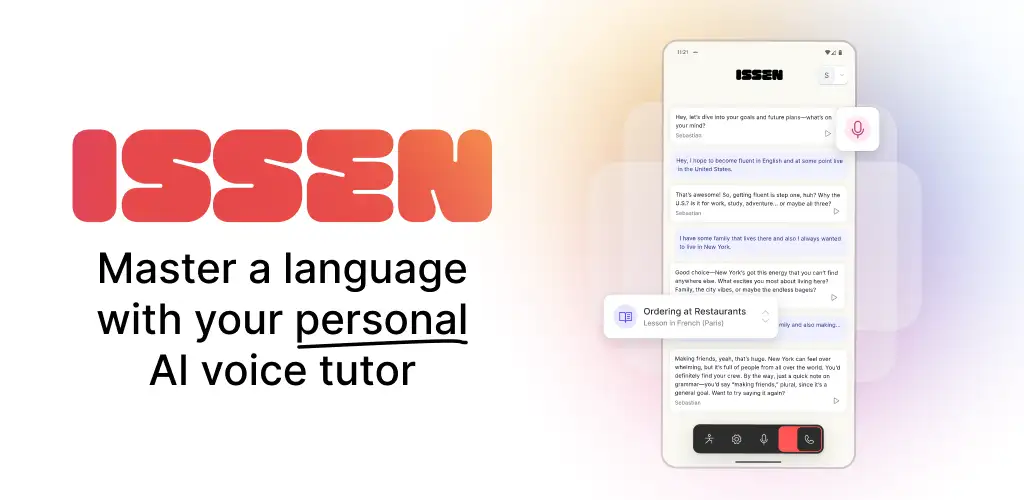
- ISSEN is an on-demand AI voice tutor built to supply daily speaking reps alongside, not instead of, grammar study and real-world exposure.
What the output gap actually costs you
Producing language, even badly, forces your brain to retrieve words under real-time pressure, notice the gaps in what you know, and build the automaticity that reading and listening alone never train. Waiting until you feel ready postpones the exact skill you are trying to build.
This is the core insight behind Merrill Swain's Output Hypothesis, drawn from Canadian French immersion classrooms. Students received years of rich comprehensible input and could follow their teachers easily, yet their spoken French stayed inaccurate. Comprehension does not require you to choose a verb tense, retrieve a noun's gender, or assemble a clause in real time. Speaking does.
When you can follow a podcast but freeze mid-sentence in conversation, the problem is structural. You have trained recognition and left production untouched.
Why speaking early accelerates acquisition
Swain identified three functions that only production activates, and each one changes what your brain does with the language you already have.
- Noticing: reaching for a word and failing to find it flags the gap in a way reading past it never does. The failure itself is the signal.
- Hypothesis-testing: guessing at a verb form and hearing how a listener responds turns a memorized rule into one your grammar system actually applies under pressure.
- Metalinguistic reflection: assembling a sentence out loud forces conscious attention to form (tense, preposition, agreement) that silent study routes around.
This is why two weeks of daily speaking often moves things two years of study never touched, which is central to effective language learning techniques. You are running the knowledge you already have through the circuits that produce speech.
The freeze response: what delaying output produces
You know the feeling. A native speaker asks you something simple, your ears catch every word, and then nothing comes out. Your vocabulary is fine. Your grammar is fine. The pathway from thought to sound has never been trained.
Automaticity is built through production reps, and recognition reps do not substitute for them. Every month you defer speaking is a month that pathway stays cold.
The emotional cost compounds. Each avoided conversation reinforces the belief that you are not ready, which raises the stakes of the next attempt, which makes avoidance feel safer, a cycle covered in depth in overcoming foreign language speaking fear. Anxiety fills the space where practice should have been.
How to balance input and output at different levels
There is no clean formula for how much input versus output you need. The ratio changes as your linguistic base grows, and the straightforward answer is directional.
At A1, you have almost nothing to produce with, so listening and reading do most of the work. By A2 you can push short exchanges into every session. From B1 onward, the balance flips: retrieval speed becomes the bottleneck, and only speaking trains that, which is why AI language tutoring for speaking fluency has become a practical option at that stage.
Level | Input | Output | Priority |
|---|---|---|---|
A1 | 80% | 20% | Scripted exchanges, high-frequency phrases |
A2 | 70% | 30% | Simple unscripted turns on familiar topics |
B1 | 50% | 50% | Daily conversation on real-life topics |
B2 | 40% | 60% | Extended argument, opinion, narration |
C1 | 30% | 70% | Register changes, abstract discussion |
Treat these as anchors, not quotas. A B1 learner with a job interview next month should push output higher.
Practical activities for language output practice speaking
Start with the lowest-stakes drills and layer up as your tolerance for exposure grows. The order below moves from silent, private practice toward unpredictable exchange with another person.
- Internal narration. Describe what you are doing in your head as you cook or walk, one of several solo language speaking practice techniques that trains retrieval speed and vocabulary access without the pressure of being heard.
- Active production out loud. Narrate the same activities aloud, then describe your surroundings sentence by sentence. Builds articulation and mouth mechanics without correction or unpredictability.
- Recording and listening back. Speak for two minutes on a prompt, replay it, note two fixes, redo. Surfaces errors your ear misses in real time.
- Shadowing. Repeat native audio immediately after hearing it, matching rhythm and stress. Trains prosody, not original production.
- Conversation practice. Real exchange with a tutor, partner, or AI voice tutor. Trains real-time response, negotiation of meaning, correction, and the discomfort of being misunderstood.
Solo work builds the raw material; conversation is where that material becomes actual speech under real-time pressure.
How to practice speaking with no conversation partner
If you have no one to speak with, you have three real options, and they work best in a specific order.
- Language exchange communities like Tandem and HelloTalk pair you with native speakers who want to learn your language. Free, but scheduling is unpredictable and quality varies.
- Human tutor marketplaces like italki and Preply give you scheduled sessions with structured accountability, worth comparing against the best language learning apps for speaking if daily reps are the goal. Great for weekly correction, expensive as a daily rep engine.
- AI voice tools give you on-demand conversation at any hour, with no social cost for early mistakes. A 2024 AI chatbot speaking review reports gains in anxiety reduction, confidence, and speaking outcomes.
Start with AI reps to build baseline confidence. Add human partners once you can finish a session without abandoning sentences mid-thought.
How to get past language speaking anxiety
More than half of foreign language learners report high speaking anxiety, according to Horwitz et al. (1986), drawn from three overlapping sources: general communication apprehension, fear of negative evaluation, and test-linked pressure.
The mechanism is simple. Every stumble in front of a person carries a small social cost, and your brain remembers.
Two things lower that cost enough to keep you practicing:
- Volume in a low-stakes setting. Enough reps that stumbling stops registering as a threat. AI voice practice has shown measurable anxiety reduction across multiple studies, largely by removing the perceived human evaluator.
- Graduated exposure to real people. AI reps lower the floor; confidence with humans is built with humans. Bring in tutors or exchange partners once your first sentence no longer feels like a cliff.
How ISSEN fits into your speaking practice from day one
Every argument above lands on the same practical problem: you need a speaking partner who is available when you are, patient with your stumbles, and cheap enough to use daily. ISSEN is built to close that gap, with the caveat that daily voice reps sit alongside grammar study and real-world exposure, not on top of them.
Open the app and you are in a live voice conversation within 30 seconds, putting it among the best AI language tutors for conversation. The tutor drives the exchange, adjusts pace to keep you in the i+1 band as you speak, and pulls flashcards from sentences you actually produced, anchoring review to your own conversation history.
Progress is measured in minutes of spoken output, not streaks. Use ISSEN as the daily volume layer; layer in a human tutor on Preply or italki for scheduled accountability and targeted work on fossilized errors.
Try ISSEN free for 10 minutes at issen.com and see how a conversation feels when you start speaking on day one.
Final thoughts on closing the gap between knowing and speaking
The discomfort of speaking early is the mechanism, not a sign you are doing something wrong. Reaching for a word and failing to find it, guessing at a form and getting corrected, finishing a sentence before your confidence catches up: those are exactly the reps that build fluency, and none of them happen through reading or listening alone.
Consider Marta, a logistics coordinator in Warsaw who has been reading English business emails for three years and scoring well on comprehension tests. Her company just assigned her to a weekly call with a UK partner. She has four weeks. The gap she is staring at: solid receptive skills and an untrained production pathway. That is exactly the gap that output reps close. Two weeks of daily 15-minute voice sessions will not make her fluent, but they will make that first call feel less like a cliff. The production pathway needs reps under real-time pressure; that is the only thing that trains it.
Pick the lowest-stakes format available to you right now and start producing output today. Try ISSEN free for 10 minutes and get those first reps in before you talk yourself out of it.
FAQ
Is it bad to start speaking a new language before you feel ready?
Speaking early builds fluency because production and comprehension are separate skills that develop through different kinds of practice. Waiting until you feel ready postpones exactly the circuits you are trying to train. Swain's Output Hypothesis (1985) showed that comprehensible input alone leaves spoken accuracy underdeveloped, even after years of immersion. The stumbles you make on day one are the mechanism, not a sign you started too soon.
What's the right input-to-output ratio for language practice at B1 and above?
At B1, retrieval speed becomes the main bottleneck, and the balance tips toward roughly 50% output, rising to 60-70% at B2 and C1. Below that threshold, listening and reading do most of the productive work because there is too little vocabulary to drive real exchange. Treat these as directional anchors, not fixed quotas. A B1 learner with a job interview next month should push output higher regardless of the ratio.
How do I practice speaking with no conversation partner?
Layer solo drills (internal narration, out-loud description, recording yourself for two minutes and noting two fixes) with an AI voice tutor like ISSEN for real-time exchange, then bring in human partners on italki or Preply once your baseline confidence holds across a full session. Solo methods build raw material; they cannot replace the unpredictable, real-time response that turns that material into speech. A 2024 AI chatbot speaking practice review found measurable gains in anxiety reduction, confidence, and speaking outcomes from AI-based conversation practice.
ISSEN vs italki or Preply for daily speaking reps: which makes more sense?
For daily volume, ISSEN is the more practical choice because the per-session pricing on italki and Preply makes consistent daily practice expensive, a human tutor session two or three times a week cannot supply the repetition volume that automaticity requires. Human tutors on those marketplaces earn their cost through structured accountability, cultural pragmatics, and targeted work on fossilized errors that AI sessions are less equipped to diagnose. The recommended model treats ISSEN as the daily rep layer and a human tutor as the periodic correction layer.
How do I get past the freeze response when speaking a foreign language?
The freeze response comes from an undertrained production pathway, not from gaps in vocabulary or grammar knowledge, your receptive system and your spoken output system are distinct, and only speaking reps build the second one. Enough low-stakes volume, where stumbling carries no social cost, lowers the threshold enough to keep you practicing: multiple studies report measurable anxiety reduction from AI voice practice, largely because the perceived human evaluator is removed. Once your first sentence no longer feels like a cliff, bring in human partners to build the confidence that only real exchange can finish.