
How to Use AI Practice for IELTS and TOEFL Speaking (August 2026)
Getting speaking reps for IELTS or TOEFL used to mean booking a tutor or finding a conversation partner who was free when you were. Most people just practiced less than they needed to. AI changes that calculus, but only if you configure it to simulate what the actual exam demands, not settle for a casual chat. This breaks down exactly how to do that for both tests.
TLDR:
- IELTS speaking scores four equally weighted descriptors, so weak pronunciation cannot hide behind strong grammar; each area needs targeted practice.
- The 2026 TOEFL iBT removed all preparation time, replacing the old format with Listen and Repeat and Take an Interview tasks that require speaking the moment a prompt ends.
- A 44-study systematic review found shadowing improves comprehensibility, intelligibility, and fluency, making it a research-backed method for the Pronunciation descriptor and the Listen and Repeat task.
- Plan six to eight weeks of prep at working intermediate level, targeting your weakest descriptor in weeks 3 through 6 and running full timed simulations only in the final week.
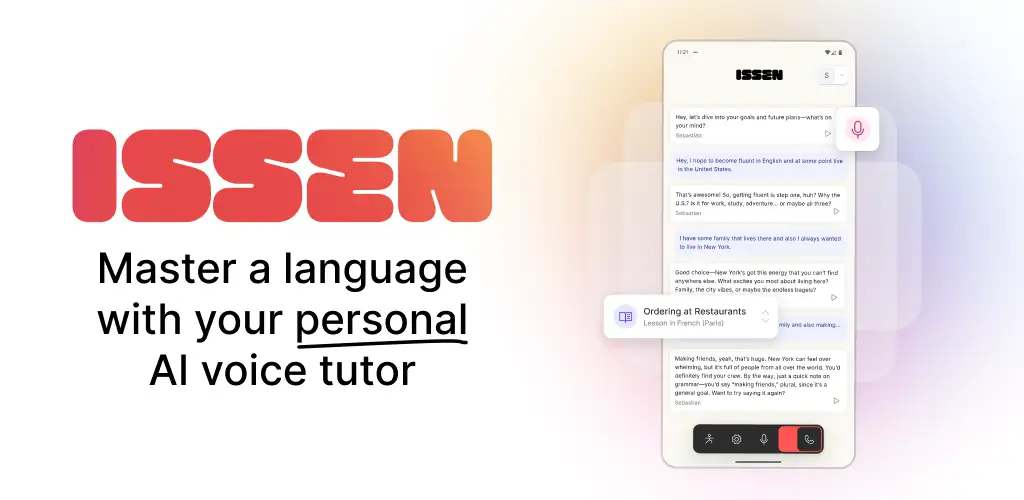
- ISSEN is a real-time voice tutor that covers unscripted conversation for Parts 1 and 3 and includes a separate Shadowing mode for American, British, and Australian English accents; it does not issue an official band score.
How the IELTS speaking test is structured and scored
The IELTS speaking test runs 11 to 14 minutes with a live examiner across three parts: familiar topics (4 to 5 minutes), a cue card with 1 minute prep and a 1 to 2 minute long turn, then abstract discussion tied to the cue card (4 to 5 minutes).
Your band score comes from four equally weighted descriptors, published by IELTS:
- Fluency and Coherence: speech rate, hesitation, and logical linking.
- Lexical Resource: vocabulary range, precision, and paraphrasing.
- Grammatical Range and Accuracy: structural variety and error frequency.
- Pronunciation: sounds, stress, rhythm, and intelligibility.
Each descriptor contributes 25 percent, so weak pronunciation cannot hide behind strong grammar. Understanding how AI speaking practice works helps you target each descriptor deliberately.
What the 2026 TOEFL iBT speaking section looks like
As of January 21, 2026, ETS replaced the old four-task speaking section with a shorter format that removes preparation time entirely. Templates from older prep books no longer apply.
The current structure has two tasks, documented by MySpeakingScore: Listen and Repeat, where 7 sentences are played aloud and you have 8 to 12 seconds to echo each one back; and Take an Interview, where 4 spontaneous questions are fired in sequence and you have 45 seconds to respond to each.
Scoring uses a 1 to 6 band across Fluency, Intelligibility, Language Use, and Organization. Integrated reading passages are gone, and so is the 15 to 30 seconds of prep. You speak the moment the prompt ends, which changes what practice needs to look like.
IELTS speaking band scores: what bands 5 through 8 require
Most test-takers hover between band 5 and band 7, and the jump between adjacent bands is smaller than it feels. Here is what the public band descriptors look like across all four scoring areas, so you can spot which one is capping your overall score.
At band 5, you maintain flow but repeat yourself and overuse connectives; vocabulary covers familiar topics with limited flexibility; basic sentences are reasonably accurate but complex forms break down; and mispronunciations reduce clarity at times. At band 6, you speak at length with some hesitation or loss of coherence; vocabulary is wide enough for most topics but word choice is occasionally off; simple and complex structures are mixed with frequent errors in complex forms; and control is mixed but you are generally intelligible. At band 7, you speak at length without noticeable effort and hesitation is language-related instead of content-related; vocabulary is flexible and includes less common items with collocation awareness; complex structures appear with flexibility and error-free sentences are frequent; and your L1 accent has minimal effect on intelligibility. At band 8, speech is fluent with only occasional repetition and produces coherent extended discourse; vocabulary is wide and used fluently with skillful paraphrase; a wide range of structures is used flexibly and the majority are error-free; and you show consistent flexibility to convey meaning precisely.
Examiners award half-bands (5.5, 6.5, 7.5) when your performance splits across two adjacent descriptors.
What AI can and cannot do for speaking exam practice
Before you build a routine around any AI tool, get the boundary straight. AI voice practice can put you inside unscripted exchanges, expose the grammar and vocabulary gaps you rehearse around in silence, and give you the volume of low-stakes reps a weekly human tutor cannot match. That contrast is covered in detail in this AI vs. human tutor for speaking comparison.
What it cannot do is issue an official band. No AI tool grades IELTS or TOEFL for the record. Any score estimate from a chatbot is directional feedback only; treating it as a predictor is how candidates walk in mispriced.
How to practice IELTS Part 1 and Part 3 with AI
Parts 1 and 3 reward what an AI tutor produces well: spontaneous follow-ups on a single thread. Part 1 wants extended, natural answers about your hometown or work. Part 3 pushes you to speculate, compare, and defend an opinion tied to your cue card.
Set the tutor to interviewer mode and pick one Part 1 topic, since speaking practice in your language routine compounds faster when sessions have a clear format. Answer, then let it pick apart your response with the same "why" and "can you give an example" prompts a real examiner uses.
For Part 3, ask the tutor to challenge your position after every answer. Drill speculative structures out loud: "it might be the case that," "one possible reason is," "if that trend continued." A 2024 AI chatbot speaking practice review reports gains in anxiety reduction, confidence, and speaking output, which matter most when Part 3 answers collapse the moment questions turn abstract.
How to practice the IELTS Part 2 long turn with AI
Part 2 punishes anyone who has only practiced dialogue. You get 1 minute to plan, then 1 to 2 minutes of solo talking with no interruptions, followed by one or two follow-ups that hand you into Part 3.
Tell the tutor to issue a cue card, stay silent for 60 seconds while you note ideas, then listen without interjecting for up to 2 minutes. It closes with two short follow-ups tied to the card, which becomes your Part 3 warm-up.
Drop any of these into your session:
- Describe a book you recently read and why you picked it up.
- Describe a place you visit to relax.
- Describe a skill you want to learn in the next 5 years.
- Describe a person who influenced your career choice.
- Describe a piece of tech you find hard to use.
- Describe a decision that turned out well.
- Describe a public figure you admire but disagree with.
- Describe a change you want to see in your city.
Record the long turn. Playback exposes filler words and abandoned sentences faster than any tutor feedback, and AI English learning for non-native speakers covers why this self-monitoring step accelerates progress.
How to practice TOEFL iBT speaking with AI in 2026
For Listen and Repeat, run sentence-repetition drills: the tutor plays a target sentence, you echo it back at matching pace. Shadowing builds the phonological memory this task scores against.
For Take an Interview, the killer is zero prep. Configure the tutor to fire a question and cut you off at 45 seconds with no warm-up chatter. Rotate through prompts across the four topic categories:
- Describe a time you helped someone through a difficult decision.
- Do you prefer working alone or on a team, and why?
- Should universities require an internship before graduation?
- If you could live in any city for a year, which would you choose?
- Talk about a skill you picked up in the last 12 months.
- What is one change your country should make in the next decade?
Run 6 back to back. That is how you train the reflex of speaking before you have finished deciding what to say.
How shadowing improves pronunciation for IELTS and TOEFL
Shadowing means playing a native clip and echoing it back with near-zero delay, matching rhythm, stress, and intonation. A 44-study systematic review found it improves comprehensibility, intelligibility, accentedness, fluency, and prosody, which maps onto what graders reward: TOEFL Speaking scores phonological accuracy, and IELTS Pronunciation carries a quarter of your band.
Run a session like this:
- Pick a 30 to 60 second clip at natural speed (podcast, news, TED talk).
- Play one sentence, shadow it immediately, no pause to translate.
- Loop it 3 to 5 times until your prosody tracks the speaker's.
- Log the sound that keeps slipping (final consonants, question rise, stress on multi-syllable words) and drill it in isolation before the next pass.
How long to practice speaking before the exam
Six to eight weeks is the realistic ramp for a candidate already at working intermediate level, and pairing that schedule with effective language learning techniques accelerated by AI keeps each week purposeful. Compress it further and you skip the descriptor work that lifts you a half band.
- Weeks 1-2: format familiarization and fluency volume. 20-30 minutes daily on Part 1 topics and interview drills, without scoring yet.
- Weeks 3-6: target your weakest descriptor. If pronunciation caps you, shift half your sessions into shadowing. If lexical resource is thin, drill paraphrase and collocation inside Part 3 prompts.
- Final week: full timed simulations end to end, no restarts.
Self-scoring is directional. Book one mock with a certified IELTS examiner or an official TOEFL scoring service before test day, since external calibration for AI speaking reps built through daily reps needs that external checkpoint to calibrate.
AI speaking practice tools compared
No third-party AI tool issues an official IELTS or TOEFL band. Use the table below to match a tool to the specific gap you diagnosed above.
Tool | Unscripted conversation | Timed exam conditions | Pronunciation feedback | Approx. cost |
|---|---|---|---|---|
ISSEN | Yes, real-time voice tutor | Configurable via prompt (cue cards, 45s cutoffs) | Separate Shadowing mode | ~$20 to $29 USD/month |
ELSA Speak | Limited; scripted drills | No exam simulator | Phoneme-level in-app | ~$12/month |
LanguaTalk (Langua) | Yes, AI voice | Not exam-specific | Post-session written | ~$15-25/month |
Preply (human tutors) | Yes, examiner-trained tutors | Yes, if tutor runs a mock | Human correction in real time | ~$15-40/session |
ETS / IDP official practice | Scripted only | Yes, mirrors real timing | Automated on some tasks | ~$40-90/test |
Verify pricing on each product's site before subscribing. Exam simulators give you timing without unscripted talk; pronunciation apps give phoneme drills without discourse; only human tutors or best AI language tutors for conversation give unscripted exchanges at daily volume.
ISSEN for IELTS and TOEFL speaking preparation
ISSEN is built to fill the gap this article names: unscripted speaking volume under time pressure. Reviews of the best AI voice tutors for language learning consistently flag timed unscripted practice as the hardest feature to find. It runs on iOS, Android, and web as a real-time voice tutor across 60+ languages, and its open conversation mode handles the spontaneous follow-ups Parts 1 and 3 demand. Shadowing, a separate dedicated mode, covers American, British, and Australian accents for the Pronunciation descriptor and the 2026 Listen and Repeat task. Conversation-anchored SRS pulls vocabulary from your own sessions. ISSEN does not issue an official band, but at a flat monthly price it supplies reps per-session tutoring cannot. Start a 10-minute conversation with ISSEN.
Final thoughts on building speaking confidence for IELTS and TOEFL
Both exams score what you produce in real time, so the only preparation that counts is speaking out loud, repeatedly, before the test date. Shadow for pronunciation, drill spontaneous responses for fluency, and treat your weakest descriptor as the one that gets the most session time in weeks three through six. No AI tool replaces an official mock, but it supplies the daily volume that makes the mock feel less like a surprise.
Consider Nadia, a logistics manager in Dubai preparing her IELTS retake in eight weeks. She has a band 6 from two years ago and needs a 7 for a UK work visa application. Her Fluency and Coherence score is the bottleneck: hesitations and self-interruptions surface the moment a Part 3 question turns abstract. Over the next two years, AI tutors will get better at targeting exactly that: identifying the specific descriptor costing a candidate half a band and adjusting conversation difficulty in real time to push against it. Right now, ISSEN's open conversation mode already gets you most of the way there: unscripted exchanges, spontaneous follow-ups, and a Shadowing mode for the Pronunciation work that runs alongside it. Start a 10-minute conversation with ISSEN to put that practice in motion.
FAQs
Can you use AI speaking practice to prepare for IELTS and TOEFL, or do you need a human examiner?
AI speaking practice covers the gap that matters most before test day: unscripted conversation volume at daily frequency. What it cannot replace is an official band score or the final mock with a certified examiner. Book one of those in the week before your test. Use AI for the reps; use a human for the calibration.
ISSEN vs ELSA Speak for IELTS speaking prep: which one covers more?
ELSA Speak focuses on phoneme-level drills, which helps with the Pronunciation descriptor but leaves Fluency, Lexical Resource, and Grammatical Range untrained. ISSEN runs open-ended voice conversations you can configure for Part 1 topics, Part 2 cue cards, and timed 45-second responses, with a separate Shadowing mode for pronunciation work, so it covers all four IELTS descriptors in a single tool.
How do I practice IELTS Part 2 with an AI tutor?
Tell the tutor to issue a cue card, stay silent for 60 seconds while you note your ideas, then listen without interrupting for up to 2 minutes before closing with two short follow-up questions. Record your long turn and play it back. Filler words and abandoned sentences show up on playback faster than any tutor feedback will catch them in the moment.
Does the 2026 TOEFL speaking section still use preparation time before each question?
No. ETS removed preparation time entirely as of January 21, 2026. The current format fires questions and expects you to speak immediately, which means any practice routine built around 15 to 30 seconds of prep is training the wrong reflex. Configure your AI tutor to cut you off at 45 seconds with no warm-up. That is the condition the actual test scores you under.
What is the realistic timeline for improving your IELTS speaking band with daily AI practice?
Six to eight weeks is a reasonable ramp for a candidate already at working intermediate level, with the first two weeks focused on format familiarity and fluency volume before you target your weakest descriptor. That timeline assumes 20 to 30 minutes of daily practice. Skipping the descriptor work to compress the schedule is how candidates get stuck half a band below their target.