
How Long to Reach Korean Fluency? September 2026
When was the last time you finished a Korean lesson and felt ready to hold an actual conversation? Probably never, because textbooks and streak-based apps train recognition, and Korean punishes you the moment you need to produce a sentence with the right honorific in real time. That's the reason how hard Korean is to learn has less to do with Hangul or particles than with getting daily reps of pushed spoken output. We'll break down the realistic timeline stage by stage and show you where the hours can actually shrink.
TLDR:
- FSI places Korean in Category IV at 2,200 class hours to Professional Working Proficiency; conversational B1/TOPIK 3 lands around 1,000 hours of active practice.
- Hangul takes a weekend, but SOV word order, particles, three-way consonant contrasts, and honorific switching (반말/존댓말/하십시오체) drive the real timeline.
- Most learners plateau at A2/TOPIK 2 because textbooks train recognition; Swain's Output Hypothesis (1985) shows production under pressure is what closes the gap.
- A 6.5-hour week mixing daily AI voice conversation, Shadowing drills, and conversation-anchored SRS beats 2 hours of gamified apps for reaching B1 inside a year.
- ISSEN is a real-time AI voice tutor that supplies daily Korean speaking reps and remembers past sessions, with pronunciation work handled separately in Shadowing mode.
Introduction
So how long does it take to learn Korean, really? Six months? Two years? The real answer depends on how many hours per week you can put in, what you count as "learned," and whether your practice includes speaking or just reading grammar notes on the train.
Here's the ballpark most people don't want to hear: the US Foreign Service Institute places Korean in Category IV, its "super-hard" tier alongside Japanese, Mandarin, and Arabic, and estimates roughly 2,200 class hours to reach Professional Working Proficiency. That's the diplomat benchmark, not the "chat with your in-laws in Seoul" benchmark, and the two timelines look very different.
This post breaks down what each stage looks like using CEFR and TOPIK milestones, why traditional study drags the timeline out, and where a real-time AI voice tutor compresses the parts that used to require a human on the other end of a Zoom call.
The real answer: how long Korean really takes
The FSI figure is the ceiling, not the target most learners need. Professional Working Proficiency means handling policy discussions in Korean, which is a different animal from ordering samgyeopsal or holding your own at dinner with your partner's family in Busan. (For a Category II comparison, see how long it takes to learn French.) For conversational fluency around B1 to low B2, a more realistic self-directed target is roughly 1,000 to 1,500 hours of active practice, where "active" means producing Korean, not passively watching dramas with English subs.
Here's what that looks like in calendar time:
Commitment | Hours/week | To conversational (~1,000 hrs) | To professional (2,200 hrs) |
|---|---|---|---|
Casual | 3 | ~6.5 years | ~14 years |
Committed | 8 | ~2.5 years | ~5.3 years |
Intensive | 20 | ~1 year | ~2.1 years |
Immersion | 40+ | ~6 months | ~1 year |
Two caveats. This is arithmetic, not a fluency guarantee, and totals assume deliberate practice with real speaking reps. (For a Category I language comparison, see how long it takes to learn Spanish.) The variable you can actually compress is speaking practice availability: hours spent waiting for a tutor slot or staring at a textbook because nobody's around to talk to are the ones AI removes from the equation.
What makes Korean easy or hard for English speakers
Hangul is the easy part
Hangul is the rare gift Korean gives English speakers. Commissioned by King Sejong in the 15th century for mass literacy, the system is phonetic and systematic. Most people read it within a week, and plenty crack it in a weekend.

SOV word order and particles
Korean puts the verb at the end. "I coffee drink" is the shape, and it takes weeks before it stops feeling backwards. Particles glued to nouns (은/는, 이/가, 을/를) mark grammatical role, so position stops carrying the weight it does in English.
Honorifics and speech levels
Korean bakes social hierarchy into verb endings: 반말 with a close friend, 존댓말 with a colleague, 하십시오체 in formal settings. Pick the wrong level with your girlfriend's father and you've made a social mistake, not a grammar one.
Pronunciation, batchim, and listening speed
The three-way consonant contrast (ㄱ plain, ㅋ aspirated, ㄲ tense) collapses into one sound for most English speakers. Final consonants shift depending on what follows. Pellegrino et al. (2011) found lighter-syllable languages like Korean clip along at higher syllable rates, so your ears need time to catch up.
Fluency milestones: what each stage actually looks like
CEFR / TOPIK | Approx. active hours | What you can do | Example |
|---|---|---|---|
A1 / TOPIK 1 | 80 to 120 | Order food, introduce yourself | 안녕하세요, 저는 마리아예요. ("Hello, I'm Maria.") |
A2 / TOPIK 2 | 200 to 300 | Handle daily errands, small talk | 이 커피 너무 뜨거워요. ("This coffee is too hot.") |
B1 / TOPIK 3 | 500 to 700 | Hold 10-minute conversations, describe experiences | 어제 친구랑 홍대에서 저녁 먹었어요. ("I had dinner with a friend in Hongdae yesterday.") |
B2 / TOPIK 4 | 900 to 1,200 | Follow K-dramas without subs, discuss opinions | 재택근무가 생산성에 좋은지 잘 모르겠어요. ("I'm not sure remote work is good for productivity.") |
C1 / TOPIK 5 | 1,600 to 2,000 | Work in Korean, argue nuance | 정책의 장기적 영향을 고려해야 합니다. ("We must consider the policy's long-term impact.") |
C2 / TOPIK 6 | 2,400+ | Near-native, literary/professional register | 그 소설은 인간 존재의 본질을 탐구한다. ("That novel examines the essence of human existence.") |
The jump most learners underestimate sits between B1 and B2. Doubling your hours is where casual studiers quit, because reading grammar books stops moving the needle and speaking reps become the real constraint. Adults working through this plateau benefit from the approaches covered in the adult's guide to language learning. A learner who spends 700 hours producing Korean out loud will speak more confidently at B1 than one who logged 1,200 hours of passive drama-watching.
Why traditional methods take so long
Textbooks and gamified apps train the wrong muscle for Korean. You drill Hangul, memorize particle rules, and stack vocabulary, all of which build recognition. Recognition is what fails you when a barista in Yeonnam-dong asks a follow-up you didn't rehearse.
This is where most learners plateau around A2 or TOPIK 2. Merrill Swain's Output Hypothesis makes the mechanism explicit: producing language under real-time pressure forces you to notice gaps that comprehension alone leaves invisible. That principle sits behind the most effective language learning techniques (Swain, 1985). Reading a sentence with 존댓말 and generating one on the spot are separate skills.
Korean punishes this gap. You pick the right honorific for the person in front of you, drop subjects the way natives do, and parse speech at a syllable rate your ears haven't calibrated to. Tapping multiple-choice answers trains none of it.
How AI tutoring compresses the timeline
The compressible variable in your Korean timeline is access to speaking practice, not total hours. Two inputs move fluency fastest: pushed spoken output and immediate conversational response. Both historically required a human on the other end, which meant scheduling, cost, and the social stakes that trigger the freeze.
AI voice tutors remove that bottleneck. If you're new to the category, AI language learning explains how it works and why it outperforms passive study. A 2024 review of AI speaking chatbots found benefits across anxiety reduction, confidence, and speaking outcomes, which matters for learners who avoid opening their mouths in Korean until they feel "ready."
ISSEN is one implementation: a real-time voice tutor that adapts vocabulary and pace within a turn, remembers the particle you botched last Tuesday, and runs in background mode so a walk to the subway becomes 15 minutes of spoken Korean. Pronunciation work lives in a separate Shadowing mode, where you drill batchim and the plain/aspirated/tense consonant contrast.
A realistic schedule to reach conversational Korean faster
Twelve months to B1 is doable for a working adult, but only if the daily block is short, spoken, and non-negotiable. Here's a week that adds up to about 6.5 hours without eating a weekend.
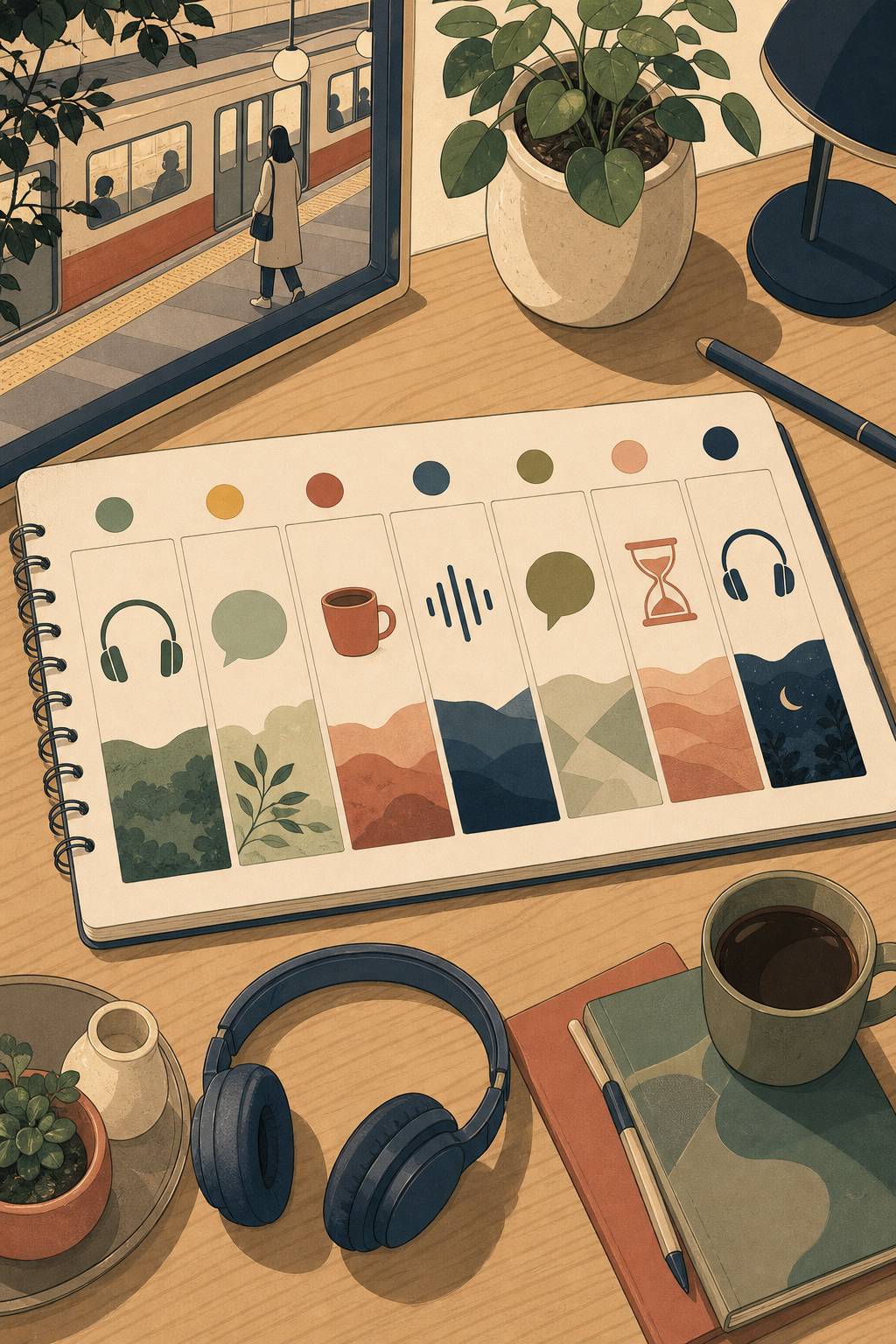
Sample week (about 6.5 hours total)
- Monday to Friday: 20 minutes of AI voice conversation, cycling 반말 and 존댓말 so honorific switching becomes reflex.
- Mon/Wed/Fri: 15 minutes in Shadowing mode drilling batchim and the plain/aspirated/tense consonant contrast.
- Tue/Thu: 15 minutes reviewing conversation-anchored SRS cards pulled from the week's sessions.
- Weekend: 45 minutes of passive input (K-drama or podcast) followed by a 30-minute free-form conversation on what you watched.
Two hours of Duolingo on Saturday looks like more time and moves you less. Gamified apps optimize for streaks and recognition; you finish with points and no spoken reps. Daily retrieval under conversational pressure is what turns particle rules and honorific endings into automatic speech.
Common mistakes that slow learners down
- Skipping Hangul for romanization. Romanization hides batchim and flattens the plain/aspirated/tense consonant contrast, building habits you'll spend months unlearning. Give Hangul 3 to 5 focused days first.
- Delaying honorifics. 요-form-only learners freeze when a boss speaks to them; 반말-only learners come across as rude. Practice 존댓말 and 반말 from week one.
- Studying particles like vocabulary. 은/는 versus 이/가 lives in discourse context, not glossaries. Learn particles inside spoken sentence patterns.
- Waiting to feel "ready" to speak. Passive knowledge never converts to speech without production reps under pressure. Start in week one.
- Watching K-dramas with English subtitles as "study." Reading English while hearing Korean trains you to translate, which kills real-time comprehension. Rewatch with Korean subtitles or none, and shadow lines aloud.
- Drilling only textbook Korean. Living Korean drops subjects and switches register mid-conversation; textbook sentences sound stilted at a pojangmacha. Practice casual and formal side by side.
FAQ
Can I become conversationally fluent in Korean in 6 or 12 months?
Six months to solid B1 is possible but usually demands 20+ hours a week of daily spoken output. Twelve months at 8 to 10 hours weekly is more realistic for working adults, assuming most hours produce Korean out loud.
Is Korean harder than Japanese or Mandarin?
FSI groups all three in Category IV. Korean offers the easiest writing system thanks to Hangul but shares Japanese's grammatical distance from English (SOV order, particles, honorifics). Mandarin adds lexical tones Korean lacks.
Do I need to live in South Korea to become fluent?
No, but you need something replicating that daily interaction. A 2024 study-abroad meta-analysis found medium-to-large effects, with interaction quality driving most gains. Daily AI voice practice covers that variable without the plane ticket.
How much does reaching Korean fluency cost?
At $20 to $40 USD an hour, 1,000 hours with a human tutor runs $20,000 to $40,000. AI voice tutors cost a fraction of that, and AI language tutoring for speaking fluency explains how the model is reshaping what daily practice looks like. Most serious learners blend both: AI for daily reps, humans for periodic correction.
Can AI replace a human tutor for Korean?
Not entirely. An AI voice tutor supplies daily speaking volume a human tutor cannot match at $30 a session, while a human handles cultural pragmatics, fossilized errors, and accountability. The two work best stacked.
Conclusion
The realistic Korean timeline lands around 1,000 hours of active practice for conversational B1 or TOPIK 3, and roughly 2,200 hours for professional proficiency. Weekly speaking hours are the right unit. Three hours a week stretches B1 across half a decade; ten hours a week pulls it inside two years.
Daniel is a software engineer in Berlin relocating to Seoul next spring. He has eight months, a stalled TOPIK 2, and standups with future colleagues that will happen in Korean whether he's ready or not. His ISSEN tutor remembers last Tuesday's conversation about apartment hunting in Mapo and opens the next session circling back to the 하십시오체 endings he flattens into 요-form at work. Background mode turns his U-Bahn commute into 25 minutes of spoken Korean he wouldn't otherwise bank.
Try ISSEN free for 10 minutes and start banking Korean speaking hours today.
Final thoughts on learning Korean to fluency
The math points to 1,000 hours of active practice for conversational Korean, and the compressible part of that number is your access to real speaking time. Protect a short daily window, drill honorifics out loud, and let speaking reps carry the weight that textbooks cannot. Small consistent blocks beat weekend cram sessions every time.
Start your first conversation with ISSEN and add today's speaking hour to the total.