
How Long Does It Take to Learn Mandarin? (And How AI Cuts That Time in June 2026)

When you ask how long it takes to learn Mandarin, the textbook answer is 2,200 hours to professional proficiency and roughly half that to hold a conversation. What nobody mentions is that most of those hours get wasted on flashcard drills that don't transfer to real speech. You can spend two years recognizing characters and still panic when someone at the office switches to Mandarin mid-sentence, because reading and speaking are two separate skills that most study plans treat as one.
TLDR:
- Mandarin takes roughly 2,200 hours to reach professional fluency per FSI estimates, or 1,100 hours for basic conversation.
- Tones and characters create the steepest learning curve, but grammar gives English speakers a break.
- Most learners hit a plateau when passive study fails to convert into real-time speaking ability.
- AI voice tutors compress timelines by giving you unlimited speaking reps that cost too much with human tutors.
- ISSEN pairs real-time conversation practice with spaced repetition tied to sentences you actually used.
The Honest Answer: How Long Mandarin Really Takes
Mandarin sits in Category V of the Foreign Service Institute's difficulty rankings, alongside Cantonese, Japanese, Korean, and Arabic. The FSI estimates 88 weeks or roughly 2,200 hours to reach professional working proficiency (S-3/R-3), the level where you can handle a meeting or argue a point without freezing.
Conversational ability comes earlier. Around 1,100 hours, you can hold simple conversations and follow most everyday speech.
Study intensity | Hours per week | Months to 1,100 hours | Months to 2,200 hours |
|---|---|---|---|
Casual | 3 | 85 months (7 years) | 170 months (14 years) |
Committed | 8 | 32 months (2.7 years) | 64 months (5.3 years) |
Intensive | 20 | 13 months (1.1 years) | 26 months (2.2 years) |
Three hours a week, the default for most adults juggling work and family, puts professional fluency more than a decade out. Eight hours a week gets you there in about five years. Twenty hours a week, the pace of intensive programs, cuts it to just over two years. That math is why most people quit.
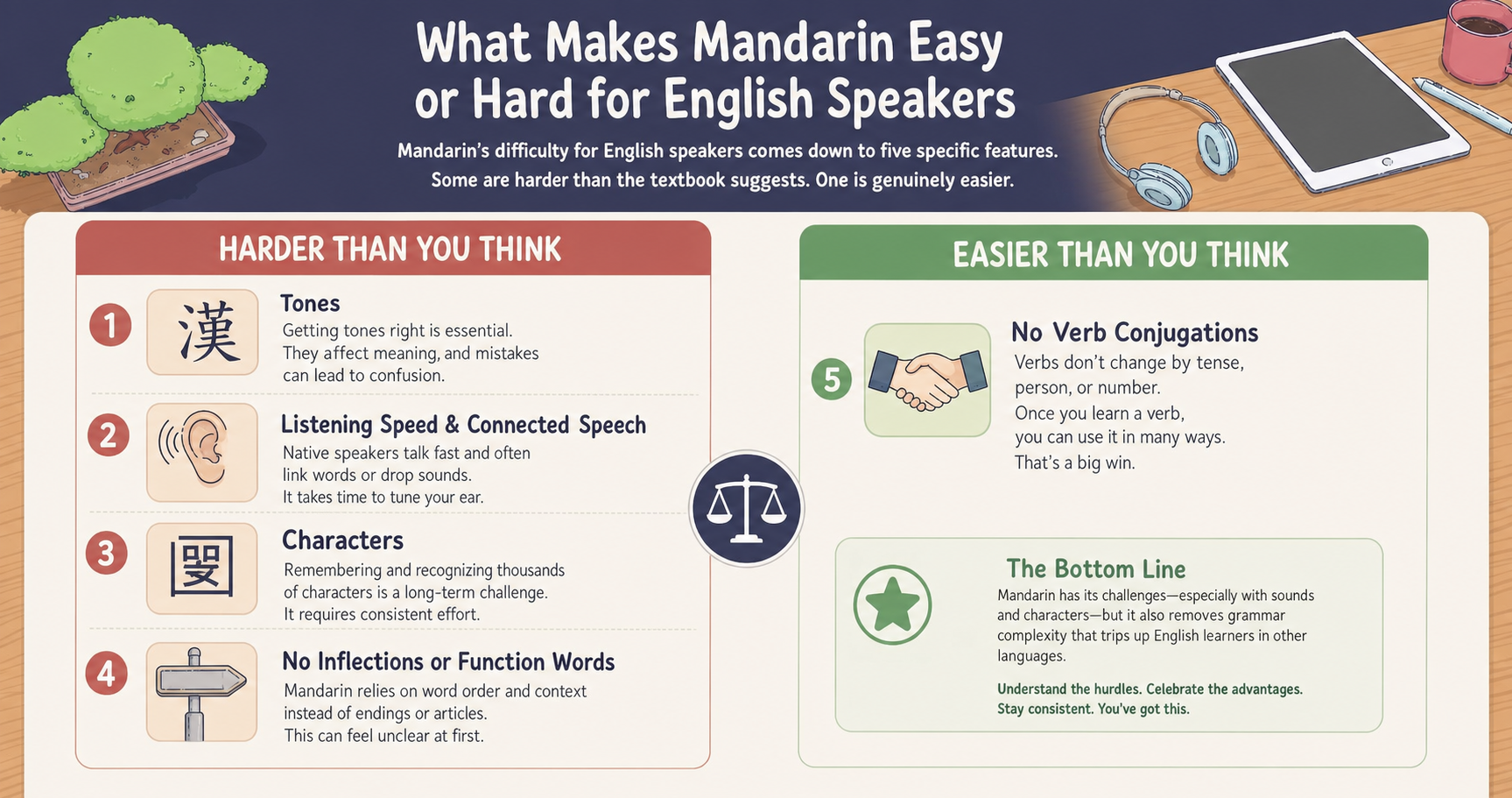
What Makes Mandarin Easy or Hard for English Speakers
Mandarin's difficulty for English speakers comes down to five specific features. Some are harder than the textbook suggests. One is genuinely easier.
Tones change meaning, not mood
Mandarin uses four main tones plus a neutral tone to distinguish words sharing the same consonants and vowels. "Ma" can mean mother, hemp, horse, or scold depending on pitch. English uses pitch for emotion, so your ear has to learn a function it has never performed.
Characters are a separate skill
Chinese has roughly 50,000 characters, with about 3,000 needed for general reading fluency. The writing system carries almost no phonetic clues, so reading and speaking become two parallel projects.
Pronunciation has unfamiliar sounds
Initials like "x," "q," and "zh" map to no English sound. Retroflex consonants require tongue positions English never asks of you, and pinyin spelling misleads readers who try to sound it out.
Grammar is the easy part
No verb conjugations, no noun cases, no gendered articles, no plural endings. Word order does the work, and time is marked with adverbs like "yesterday" instead of tense changes. After Spanish or German, this feels like a gift.
Context carries weight
Pronouns get dropped, subjects vanish when obvious, and politeness lives in word choice and indirectness. Knowing when a question is really a request takes longer to absorb than grammar ever does.
Fluency Milestones: What Each Stage Actually Looks Like
CEFR levels give you something hour counts cannot: a picture of what you can actually do in a room with another person.
CEFR Level | Approximate Hours | Real-World Ability |
|---|---|---|
A1 | 100-150 | Introduce yourself, order food, ask basic questions |
A2 | 250-350 | Discuss routine topics, describe experiences simply |
B1 | 500-700 | Handle travel, express opinions, follow main points |
B2 | 900-1,200 | Participate in detailed conversations, understand subtle speech |
C1 | 1,500-1,800 | Discuss complex topics fluently, grasp implicit meaning |
C2 | 2,000+ | Near-native comprehension across all contexts |
Here is what each level sounds like coming out of your mouth:
- A1: "Wo jiao Anna, wo shi Meiguoren." (My name is Anna, I am American.)
- A2: "Zuotian wo qu le chaoshi mai dongxi." (Yesterday I went to the supermarket.)
- B1: "Wo juede zhe ge dianying hen youqu, danshi jieju you dianr qiguai." (I think this movie is interesting, but the ending is a bit strange.)
- B2: Conditional reasoning about work decisions and policy changes.
- C1: Picking up on implied criticism and subtext in someone's speech.
- C2: Wordplay, idioms, regional humor, and shifting register without losing the thread.
Worth flagging: the FSI target of ILR Level 3 sits around high B2 or low C1, the zone of professional precision where you can argue a complex point without losing the thread. Most learners overshoot what they actually need.
Why Traditional Methods Take So Long
Most Mandarin learners hit the same wall around the intermediate level, where passive knowledge through apps and textbooks fails to transfer when someone speaks at full speed and expects a real-time reply.
Three failure points show up again and again:
- Tone fossilization. You drilled tones in isolation but never used them in connected speech, so your fourth tone collapses into your first the moment you form a sentence.
- Listening speed gap. Native Mandarin runs around five syllables per second. Textbook audio runs slower, and your ear never adjusts.
- Recognition versus recall. You can read 1,500 characters but cannot retrieve the spoken word for "appointment" when a coworker asks about your schedule.
Gamified apps make this worse by optimizing for short daily streaks instead of speaking reps, so the gap between recognition and real-time production keeps widening.
How AI Tutoring Compresses the Timeline
The bottleneck in traditional Mandarin study is speaking time. A human tutor at $25 to $40 an hour caps your reps at a few sessions a week. A voice tutor you can talk to whenever you have 10 minutes changes the arithmetic.
Research on AI chatbots for speaking practice reports gains in confidence, engagement, and speaking outcomes, with anxiety dropping enough that learners attempt output earlier. For Mandarin, that matters in four ways:
- Tone reps in connected speech. Flashcards don't teach you to hit tones mid-sentence; live conversation forces you to land them while tracking meaning.
- Input at your level. A tutor that adjusts sentence by sentence keeps you in the i+1 zone.
- Character recall under pressure. Retrieving spoken words without multiple-choice prompts builds active recall.
- Listening at native speed. Ask the tutor to speed up gradually until five syllables per second stops feeling like noise.
ISSEN runs on this model: a real-time voice tutor that adapts to your level, remembers prior sessions, and surfaces flashcards tied to the sentences you actually used. Pronunciation work lives in a separate Shadowing mode where you imitate native audio directly. For more on language learning strategies and AI-powered study methods, visit the ISSEN blog.
A Realistic Schedule to Reach Conversational Mandarin Faster
A working adult with 45 focused minutes a day can outpace someone grinding two hours of passive app time. Where those minutes go matters more than the total. Split your time: 30 minutes with an AI voice tutor for speaking reps, 15 minutes for spaced repetition and character review. Vary the speaking focus each day between free conversation, roleplay scenarios, tone drills, and discussing work or current events. Add 10 new characters twice a week and review your sentence cards daily. Take one full rest day per week.

Two mechanisms drive this. Spacing review across days produces gains for delayed retention when paired with retrieval. Speaking output forces you to notice gaps and test grammar hypotheses in real time, which silent study never triggers.
Add 20 minutes of Mandarin podcasts during your commute. Your ear adjusts to native speed while active reps build production.
Common Mistakes That Slow Learners Down
Seven patterns show up over and over in stalled Mandarin learners. Each has a quick fix.
- Avoiding speaking until you "feel ready." You never feel ready. Start outputting in week one, even if that means three sentences with a voice tutor.
- Living in pinyin forever. Pinyin is a beginner crutch, useful at the start but not a substitute for literacy since menus, signs, and messages run on characters. Begin character study by month two.
- Treating tones as optional. Learners who postpone tones often spend years undoing fossilized errors. Mark tones on every new word from day one.
- Studying in silence. Textbooks build passive knowledge that collapses in real conversation. Pair every study block with spoken reps.
- Listening only to slowed audio. Your ear calibrates to whatever speed you train it on. Add native-speed podcasts even when you catch fragments.
- Translating in your head. Mental translation creates a two-second lag. Drill short patterns until Mandarin comes before English.
- Skipping spaced repetition for characters. Use an SRS with audio and the sentence you first met the word in.
FAQ
Can I become fluent in Mandarin in 3, 6, or 12 months?
No. The FSI hour requirements rule that out for anyone with a job. At 20 hours per week, 3 months gets you solid A2, 6 months low B1, and 12 months B2 conversational ability. Professional fluency takes years.
Is Mandarin harder than Japanese or Korean?
All three sit near 2,200 FSI hours, but the shape differs. Mandarin pairs approachable grammar with steep tone and character barriers. Korean has the easiest script but demanding grammar. Japanese sits between, with gentler pronunciation across three scripts.
Do I need to live in China to become fluent?
No. Daily speaking reps at home produce the same mechanism immersion does. A voice tutor, native podcasts, and conversation partners can replicate the input volume that matters.
Can AI replace a human tutor for Mandarin?
No, and you should not want it to. Human teachers offer cultural fluency, accountability, and real connection an AI cannot match. AI handles the daily reps human tutors are too expensive and too scheduled to provide. The combination outperforms either alone.
Final Thoughts on Mandarin Study Timelines
The FSI estimate holds. Two thousand hours is real, and cutting corners on tones or characters just means you redo them later. But you can control where those hours go: flashcard grinding versus live conversation practice makes the difference between passive recognition and active recall under pressure.
Where AI voice tutoring is heading
Picture Chen, a software developer in Shenzhen preparing for a transfer to the Singapore office. Her AI tutor remembers that she struggled with the retroflex "zh" sound in last Tuesday's session, surfaces sentence cards from her discussion about agile methodology, and adjusts speed when she asks about Singapore housing law. The tutor knows she has four weeks until her visa interview and front-loads professional scenarios. In two years, that level of context-aware practice will be table stakes. Voice tutors will track what you said, where your tongue placement failed, which tones collapsed under cognitive load, and which sentence structures you avoid when nervous. The learners who start speaking reps now, before they feel ready, build the hours that matter when the tools get better.
Try ISSEN free for 10 minutes and spend your study time on the reps that transfer to real speech.