
Gamified Apps and the Speaking Gap: August 2026
Keeping a streak going feels like progress, and for a while that holds true. But at some point the tiles and word banks stop moving you forward, and every real conversation still feels like a test you haven't studied for. The gap between what you can decode and what you can actually say out loud has a specific cause, and fixing it means practicing the thing Duolingo structurally cannot ask you to do.
TLDR:
- Duolingo builds vocabulary recognition at A1 and A2, but most users hit a ceiling around low B1 because the app optimizes for daily engagement, not spoken output production.
- Swain's Output Hypothesis (1985) explains why: comprehension lets you infer meaning from context, while speaking forces you to conjugate verbs, pick prepositions, and sequence clauses under pressure you can't shortcut.
- Duolingo Max's Roleplay runs on scaffolded paths that circle back to safe questions when you drift, which builds confidence but leaves the core production gap intact past B1.
- A speaking-first study stack pairs daily AI voice reps with a human tutor on italki or Preply every one to two weeks to catch the errors that reps alone won't surface.
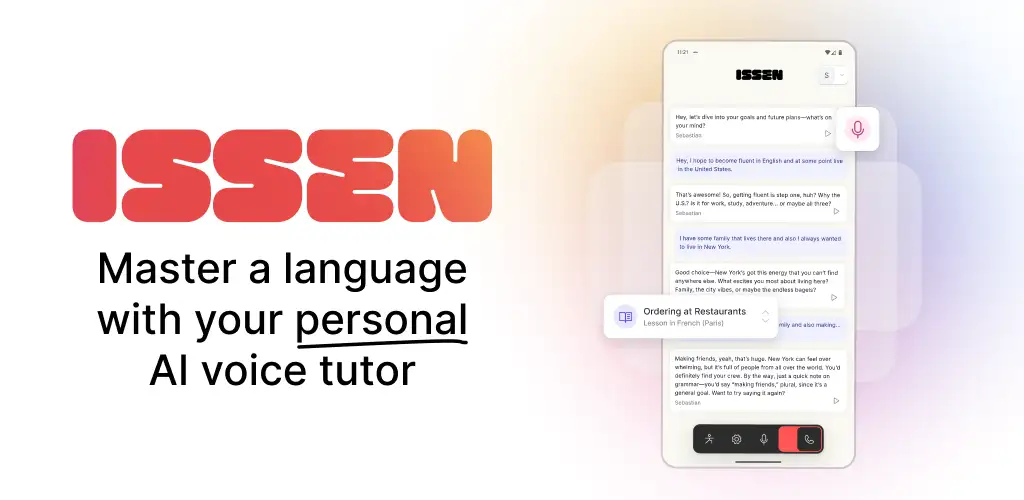
- ISSEN is an AI voice tutor that delivers open-ended, unscripted conversations with in-turn correction and hands-free background mode, priced at $20 to $29 USD per month as one input inside a broader study plan.
What gamified apps actually do well
Gamified apps get a bad rap in speaking-focused corners of the internet, and some of that criticism is deserved. Some of it isn't. Before we get to what Duolingo cannot do, it helps to name what it does well, because a lot of readers still open the app every morning.
Where these apps genuinely earn their place:
- Daily habit formation. Streaks, notifications, and five-minute lessons solve the hardest problem in adult learning, which is showing up on the days you don't feel like it.
- Passive vocabulary at A1 and A2. Tapping through short exercises builds recognition of high-frequency words faster than most language learning apps for speaking.
- A near-zero barrier to starting. No placement test, no schedule, no tutor to book.
These are real gains, and they are prerequisites for conversational fluency. Learners who can't recognize the top 500 words have nothing to draw on when a real conversation starts.
Is Duolingo enough to become fluent?
Short answer: no. If your goal is real conversation, Duolingo alone will not get you there, and no streak extension changes that.
The reason is structural. The app is built around 5 to 10 minutes a day of tapping tiles, which keeps a habit alive and grows recognition of common words, but sits nowhere near the spoken output volume conversational fluency requires. Most users hit a familiar ceiling around A2 or low B1: they can read a Duolingo sentence, follow a slow podcast, and still freeze when a barista asks a follow-up question, which is why speaking practice belongs in your routine. That gap between what you decode and what you produce is the plateau. Adding more lessons on the same side of the equation does not close it.
Why doesn't gamification produce speaking ability?
Gamification optimizes for the metric it can measure, which is daily engagement. Acquisition optimizes for productive difficulty: friction, gaps, and moments where you cannot find the word. When a product team has to choose between the two every sprint, engagement wins.
That choice shows up in three mechanics:
- Multiple choice removes active retrieval. Picking a tile from four options is recognition work, not the cold production speaking demands.
- Word banks skip sentence construction under pressure. Dragging pre-set tiles into order bypasses assembling a clause from memory while someone waits.
- Streaks reward showing up, not stretching. A five-minute review protects the streak; a harder conversation moves you forward and feels bad in a way apps cannot afford to feel, and that friction is part of what makes a language app immersive.
Swain's Output Hypothesis (1985) predicts this: learners notice gaps only when forced to produce language, not select it from a menu.
The difference between recognition and production in language learning
Merrill Swain developed the Output Hypothesis (1985) after watching something strange in Canadian French immersion programs. Students had years of rich input from native-speaking teachers, and their listening comprehension climbed close to native levels. Their speaking did not. They understood everything and produced sentences riddled with gaps no comprehension test would catch.
Swain's diagnosis: comprehension runs on semantic shortcuts. You infer meaning from context, cognates, and one or two anchor words per sentence, without ever parsing the full grammar. Production has nowhere to hide. To say a sentence out loud, you have to choose a subject, conjugate a verb, pick the right preposition, and sequence the whole thing before your listener loses patience. That forced assembly surfaces the gaps, and that assembly work no tile-tapping session asks you to do. Swain called this the "noticing function" of output.
Does Duolingo Max fix the speaking problem in 2026?
Duolingo Max is the fair test of whether the gamified category can close the production gap. At $29.99 per month or $168 per year (verify current pricing on Duolingo's site before subscribing), the tier gives you Video Call with Lily and Roleplay scenarios in Spanish, French, German, Italian, Portuguese, Japanese, and Korean, with Explain My Answer free for all users as of January 2026 (verify on duolingo.com).
For an A2 learner who has never spoken a full sentence out loud, Video Call with Lily is a real upgrade. You get a face, a voice, and a low-stakes prompt loop. Roleplay adds scripted scenarios like ordering coffee, with the tutor holding your hand through predictable turns.
The ceiling shows up around B1. Roleplay runs on scaffolded paths: Lily circles back to safe questions when you drift, and exchanges are shaped so you rarely produce a sentence the system did not anticipate. Helpful for confidence, useless for the skill you plateau on, which is assembling language under pressure you cannot predict. That is precisely where AI language tutoring for speaking fluency opens a different path.
What to use instead of a gamified app
Four categories cover most of what works after you outgrow tile-tapping. Each fixes a different piece of the production gap, and none solves the whole thing alone.
Category | What it gives you | Where it falls short |
|---|---|---|
AI voice tutors | On-demand reps, unlimited turns, low cost per session, unpredictable prompts | Cannot replace deep cultural feedback or long-term human accountability |
Human tutors (italki, Preply) | Real cultural correction, scheduled accountability, targeted work on fossilized errors | $15 to $40 per session makes daily practice financially painful |
Immersion (media, environment) | Rich input, natural register, exposure to slang and idiom | Passive by default; input without forced output leaves the plateau intact |
Language exchange partners | Free, real humans, cultural exchange | Scheduling friction, uneven skill levels, no correction discipline |
A 2024 AI chatbot speaking practice review found benefits for anxiety reduction, confidence, and speaking outcomes, with the strongest evidence in low-stakes contexts. The practical read: AI tutors handle daily reps, and human tutors handle periodic correction of errors reps alone will not surface.
How to build a speaking-first study stack in 2026
A speaking-first stack layers daily AI voice reps, weekly or monthly human correction, and passive input as background listening. Past A2, treat unscripted output as your primary metric. Verify pricing and beta status on each product's site before subscribing.
App | Unscripted speaking | Real-time correction | Hands-free | Monthly price |
|---|---|---|---|---|
ISSEN | Yes, open-ended voice | Yes, in-turn | Yes, background mode | $20 to $29 |
Duolingo | No | No | No | Free or $14 Super |
Duolingo Max | Scripted Roleplay only | Explain My Answer post-turn | No | $29.99 |
Babbel | Babbel Speak in beta, mobile only | Beta, verify scope | No | Verify on live site |
Busuu | Community written feedback | Delayed peer review | No | Verify on live site |
Memrise | MemBot chat, mostly text | No | No | Verify on live site |
Pair one voice tool for daily reps with a human tutor on italki or Preply every one to two weeks for correction on patterns the AI misses. The AI vs. human tutor speaking tradeoffs are worth understanding before you commit.
How ISSEN fills the gap gamified apps leave
ISSEN is an AI voice tutor built around the one thing gamified apps structurally cannot deliver: unscripted spoken output under real-time pressure. Difficulty, vocabulary, and speaking pace adapt inside a single session, a hallmark of personalized language learning apps, and progress is measured in minutes of spoken output instead of streaks. ISSEN is one input inside a broader study plan, not a replacement for grammar work or real-world exposure.
- For a broader comparison, see the best AI language tutors for conversation practice. Smart turn detection means no push-to-talk. You speak, the tutor waits, and the exchange runs closer to a real conversation than a walkie-talkie.
- Background and lock-screen mode turns a walk or commute into speaking reps without staring at the app.
- Conversation-anchored SRS surfaces words inside the sentences you actually said, so review carries the grammatical frame you built them in, one feature among many in the best apps for language fluency.
- 60+ languages, flat monthly pricing of $20 to $29 USD, no per-session math.
Final thoughts on why Duolingo doesn't make you fluent
Gamified apps solve a real problem: they get you to show up. What they cannot solve is the production gap, because tapping tiles and speaking under pressure are different cognitive tasks entirely. Your reading level and your speaking level will stay mismatched until you add regular, unscripted spoken output to your stack.
Think about Mia, a logistics coordinator in Warsaw who hit B1 in Spanish after eight months of Duolingo but still freezes on customer calls with her company's new Mexico City office. Her goal: handle a 5-minute supplier call in Spanish without blanking by Q4 2026. She can read an email in Spanish without hesitating. She cannot get through a two-minute phone call without her mind blanking mid-sentence. That gap, between what she decodes and what she produces under pressure, is exactly what Swain's Output Hypothesis predicted in 1985, and that gap is what AI voice tutors are now positioned to close at scale. In two to three years, a tutor like ISSEN will know Mia's job vocabulary, her recurring error patterns from the last 30 sessions, and the fact that her next call is on Thursday. Daily reps will feel less like practice and more like prep for a specific conversation she is about to have. The principle is the same one Swain described; the friction, the cost, the scheduling, the lack of a patient interlocutor, is what keeps getting removed. Try ISSEN free for 10 minutes and see how different daily voice reps feel from daily review.
FAQs
Why doesn't Duolingo make you fluent even after months of consistent practice?
The problem is structural, not motivational. Duolingo is built around 5-10 minutes of daily tile-tapping, which trains word recognition but never asks you to produce a sentence from memory under conversational pressure. Swain's Output Hypothesis (1985) explains why that matters: gaps in your grammar and syntax only surface when you're forced to speak, not when you're selecting from a menu of options.
What should I use instead of Duolingo Max when I've hit the B1 plateau?
Duolingo Max's Roleplay feature helps at A2, but its scaffolded paths keep conversations predictable enough that you rarely have to assemble language under real pressure. At B1 and above, you need unscripted spoken output: an AI voice tutor like ISSEN for daily reps, paired with a human tutor on italki or Preply every one to two weeks to catch the errors that volume alone won't fix.
Can I build real speaking ability without a human tutor?
You can get considerably further than most learners expect, but with a clear caveat: AI voice practice handles the volume problem, not every problem. Daily sessions with an AI tutor build the automaticity that weekly human tutoring sessions can't supply at that frequency. Human tutors on Preply or italki still earn their place for catching fossilized errors and cultural nuance that accumulate over months of practice.
How is ISSEN different from Duolingo Max for speaking practice?
Duolingo Max offers scripted Roleplay scenarios with post-turn feedback, while ISSEN runs open-ended voice conversations with no push-to-talk mechanics, real-time difficulty adjustment, and background mode so sessions continue during a walk or commute. The structural difference is that ISSEN generates unpredictable conversational pressure: the condition Swain identified as the one that actually forces your brain to notice gaps.
What does a speaking-first study stack actually look like in practice?
The core structure is daily AI voice reps with a tutor like ISSEN, human correction on italki or Preply every one to two weeks, and passive input like podcasts or TV as background listening. Past A2, treat minutes of spoken output as your primary progress metric, not lessons completed or streak days maintained.